These notes were written by the person who submitted this item. Appraiser.AI has not verified them, and the AI's identification and estimate may rely on them.
AI Estimated Value
Not an official valuation
$400-600
AI estimate as of July 30, 2025 · verify with a professional before acting
AI-Generated · Verify before acting
Everything on this page is generated by AI for informational purposes only. AI can make mistakes — the AI may misidentify items or misattribute them (artist, maker, brand, designer, origin, era). This is not an official valuation and should not be used for insurance, sale, tax, estate, legal, or lending purposes — or any decision requiring a certified appraisal. It is not an authoritative claim about any person, brand, or rights holder — do not share or rely on it as a factual statement about a third party. Always consult qualified professionals before making financial decisions.
This analysis also relies on unverified notes provided by the user, which may be incomplete or inaccurate and could affect the result.
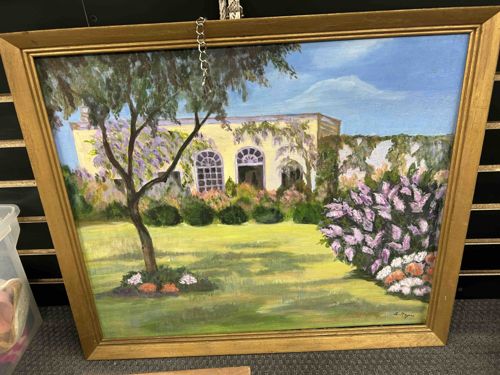
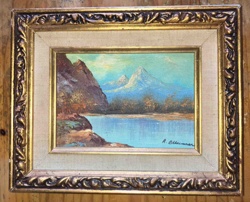
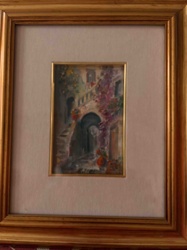
This item is an original oil painting depicting a garden scene with a large, light yellow building in the background, likely a villa or estate house. The painting is rendered in a somewhat impressionistic or realistic style with vibrant colors. The foreground features a lush green lawn, with a prominent tree, possibly a wisteria or similar flowering tree, with purple blossoms on the left side. Around the base of the tree are small clusters of white and orange flowers. To the right, there is a large bush with distinctive light purple or lavender foliage, possibly a hydrangea, with some white and orange flowers at its base. The building in the background is characterized by classical architectural elements, including arched windows. The structure is partially obscured by lush green foliage and climbing vines. The sky is a bright blue with some white clouds. The brushwork appears somewhat loose in areas, particularly in the foliage, giving a sense of texture and light, while the architecture is depicted with more defined lines. The painting is housed in a simple, rectangular wooden frame with a gold-tone finish, showing some minor wear consistent with age, specifically in the form of slight scratching or scuffing on the surface. There is a metal chain attachment at the top center of the frame, indicating it was previously hung. The visible signature in the lower right corner, confirmed by the 'A. Negri' context, indicates the artist. The overall condition appears good, with no obvious major damage, tears, or significant paint loss visible from the provided image, though specific condition issues like craquelure or discoloration would require closer inspection. Based on the style and typical framing, it likely dates from the mid to late 20th century.
AI Appraisal Report
Upon visual examination of the provided image, this Garden Scene Painting by A. Negri presents as an original oil on canvas, consistent with the description. The vibrant colors and somewhat impressionistic style, particularly in the foliage, suggest a mid to late 20th-century origin. The condition appears good overall, with no apparent tears, significant paint loss, or major damage visible from the image. The simple gold-tone wooden frame exhibits minor wear, consistent with age.
Authenticity, based solely on visual inspection, is supported by the visible signature "A. Negri" in the lower right corner, aligning with supplied context. However, full authentication would require in-person examination to verify signature execution, paint layer characteristics, and canvas age. Provenance documentation, such as purchase receipts or exhibition history, would further strengthen authenticity claims. Scientific testing (e.g., pigment analysis, carbon dating) might be necessary to conclusively determine age and materials if doubt arises.
Market conditions for works by lesser-known or regional artists like A. Negri can vary. Comparable sales typically reside in the lower to mid-range for original oil paintings of this scale and subject matter. Demand for decorative landscapes, especially those with appealing garden scenes, is generally steady. Rarity is not a significant factor here, as works by such artists are not usually considered rare unless they have achieved notable critical acclaim or historical significance not immediately evident. Factors impacting value include the appealing subject matter, visible signature, and seemingly good condition. Conversely, the lack of broader market recognition for A. Negri limits the top-end potential. Without further provenance or a documented exhibition history, the value primarily reflects its decorative appeal.