These notes were written by the person who submitted this item. Appraiser.AI has not verified them, and the AI's identification and estimate may rely on them.
AI Estimated Value
Not an official valuation
$1,200 - $1,800
AI estimate as of August 1, 2025 · verify with a professional before acting
AI-Generated · Verify before acting
Everything on this page is generated by AI for informational purposes only. AI can make mistakes — the AI may misidentify items or misattribute them (artist, maker, brand, designer, origin, era). This is not an official valuation and should not be used for insurance, sale, tax, estate, legal, or lending purposes — or any decision requiring a certified appraisal. It is not an authoritative claim about any person, brand, or rights holder — do not share or rely on it as a factual statement about a third party. Always consult qualified professionals before making financial decisions.
This analysis also relies on unverified notes provided by the user, which may be incomplete or inaccurate and could affect the result.
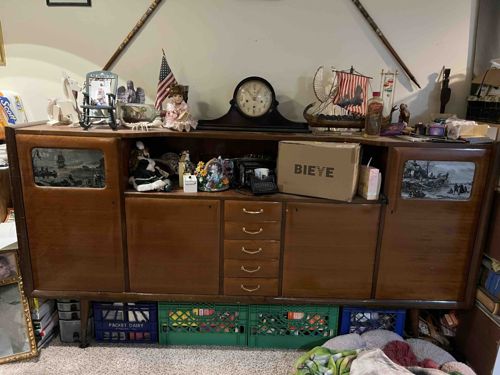
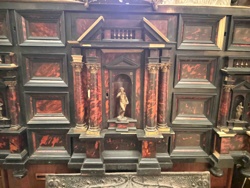
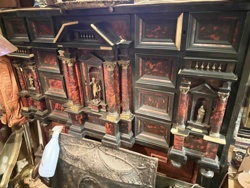
The item is a large, low-slung wooden sideboard or credenza, likely from the mid-20th century, possibly in the Art Deco or Mid-Century Modern style given its clean lines and rounded edges. It appears to be constructed from a rich, light- to medium-toned wood, possibly mahogany, teak, or a similar veneer, showing a consistent grain pattern across its surfaces. The overall form is rectilinear with gently rounded corners, particularly noticeable on the top surface and the side panels, which contribute to its sleek aesthetic. The craftsmanship suggests solid construction, though specific joint details are not discernible.
The piece features multiple storage compartments. There are two cabinet doors on the left, one on the far left and another to its right. The far-left door features an inset panel with a decorative, monochromatic landscape or seascape scene, akin to a print or bas-relief, depicting ships and figures. A similar panel is present on the far right cabinet door. These decorative inserts are a notable distinguishing element, adding character and possibly hinting at the origin or a specific artistic trend. In the center, there is a section with four drawers, each fitted with small, simple brass or possibly wooden pull handles. To the right of the drawers, there is another cabinet compartment with a solid wooden door, similar in style to the central cabinet to its left. The hardware appears minimal, consistent with the streamlined design. The piece rests on a recessed plinth base or short, possibly splayed, legs that are not fully visible due to items stored beneath, contributing to its low profile. The visible condition shows a general patina consistent with age and use, including some minor surface wear, scratches, and potentially some fading or discoloration of the wood finish, though no major damage like cracks or significant gouges are evident. The interior of the open central shelf unit reveals a dark, possibly velvet or felt, lining on the bottom. The quality appears good, indicating a well-made piece of furniture designed for both storage and display.
AI Appraisal Report
This Mid-20th Century Wood Sideboard, likely European given the owner's details, presents as a well-preserved piece with notable stylistic elements. Its clean lines, rounded edges, and recessed plinth base are consistent with Mid-Century Modern design. The wood, appearing to be a light-to-medium tone, shows a consistent grain, suggesting quality construction, possibly mahogany or teak veneer over solid wood. The condition is good, showing a general patina, minor surface wear, and some fading consistent with age, but no apparent major damage like cracks or significant gouges. The distinguishing feature is the pair of inset decorative panels depicting landscape/seascape scenes with ships and figures, which are unusual for typical MCM sideboards and might indicate a specific regional European origin or a custom commission, enhancing its unique appeal.
Market conditions for quality Mid-Century Modern furniture remain strong, though pieces with unique decorative elements like these can either appeal to a niche collector or be considered less universally appealing than more minimalist designs. Comparables typically range significantly based on designer, wood type, and condition. The demand for well-maintained, functional pieces like this is generally steady. The rarity comes from the decorative panels, differentiating it from mass-produced items.
While the visual assessment suggests authenticity of age and style, definitive verification of the wood species, construction methods, and the precise technique of the inset panels (e.g., carving, print under lacquer) would require in-person examination. Provenance documentation could significantly impact value, particularly if linked to a known designer or manufacturer. Scientific testing might confirm wood species and age. Without these, the assessment relies solely on visual cues. The unique decorative panels make this a strong candidate for an artisan-made or limited-production piece from the period.