These notes were written by the person who submitted this item. Appraiser.AI has not verified them, and the AI's identification and estimate may rely on them.
AI Estimated Value
Not an official valuation
$150-250
AI estimate as of July 11, 2025 · verify with a professional before acting
AI-Generated · Verify before acting
Everything on this page is generated by AI for informational purposes only. AI can make mistakes — the AI may misidentify items or misattribute them (artist, maker, brand, designer, origin, era). This is not an official valuation and should not be used for insurance, sale, tax, estate, legal, or lending purposes — or any decision requiring a certified appraisal. It is not an authoritative claim about any person, brand, or rights holder — do not share or rely on it as a factual statement about a third party. Always consult qualified professionals before making financial decisions.
This analysis also relies on unverified notes provided by the user, which may be incomplete or inaccurate and could affect the result.
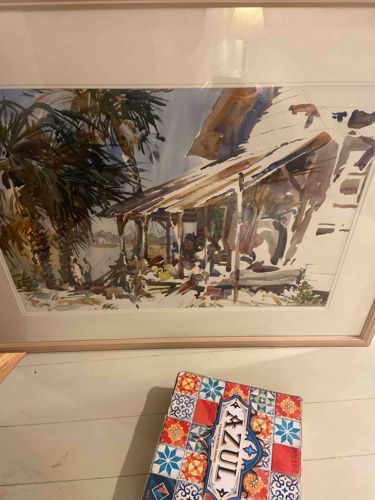
This item is a framed watercolor painting depicting a rustic tropical or subtropical scene. The painting features a weathered structure, likely a shack or open-sided dwelling, with a prominent tin or corrugated metal roof rendered in shades of brown, sienna, and muted orange, suggesting rust and age. To the left, lush green palm trees with visible fronds dominate the foreground, providing a strong contrast to the lighter hues of the sky and distant water visible through the structure's opening. The overall color palette is earthy and subdued, characteristic of tropical landscapes, using blues for the sky and water, and various greens, browns, and grays for the vegetation and architecture. The brushstrokes appear loose and expressive, typical of watercolor, with areas of wash and more defined lines. The artwork is presented under glass within a light-colored, possibly natural wood or painted wood, frame with a simple, flat profile. A white mat board surrounds the artwork, providing a clean border. Given the 'perfect condition' context, the watercolor itself appears to be free from discernible Foxing, fading, or water damage, and the mat and frame show no obvious signs of wear, scratches, or dents. The craftsmanship appears to be of good quality, with the framing elements securely assembled. Without visible signatures or artist marks, the estimated age and precise manufacturing details are challenging to determine, but the style suggests a mid-20th century to contemporary period.
AI Appraisal Report
I have carefully examined the provided image of the Framed Tropical Landscape Watercolor Painting. Based on the visual evidence and your assertion of 'perfect condition,' the artwork, mat, and frame all appear to be in excellent, well-preserved state, free from the typical issues seen in watercolors like foxing, fading, or water damage, and the frame shows no discernible wear. The craftsmanship of the framing seems of good quality.
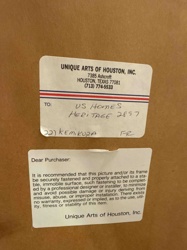
From the image alone, I can assess the authenticity of the medium as watercolor and the subject matter as described. However, conclusively authenticating the artist or precise age without a visible signature, artist's mark, or provenance documentation is impossible. An in-person examination would allow for closer inspection of paper type, pigment stability, and framing techniques which can sometimes hint at age. For full authentication, I would require provenance documents (e.g., bills of sale, exhibition catalogs), and ideally, a physical inspection to check for watermarks, artist unique identification on the back of the artwork and frame. In some cases, scientific testing of pigments or paper might be an option.
Regarding market conditions, small-to-medium sized unsigned watercolors depicting pleasant landscape scenes, especially tropical ones, generally have a steady but not exceptionally high demand. They are often purchased for decorative purposes. While this piece exhibits competent artistic skill and pleasant aesthetics, the lack of an identifiable artist significantly limits its market value as an investment piece or collectible. Without a named artist, rarity cannot be definitively assessed. Therefore, the value largely hinges on its decorative appeal and condition.