These notes were written by the person who submitted this item. Appraiser.AI has not verified them, and the AI's identification and estimate may rely on them.
AI Estimated Value
Not an official valuation
$300-550
AI estimate as of July 24, 2025 · verify with a professional before acting
AI-Generated · Verify before acting
Everything on this page is generated by AI for informational purposes only. AI can make mistakes — the AI may misidentify items or misattribute them (artist, maker, brand, designer, origin, era). This is not an official valuation and should not be used for insurance, sale, tax, estate, legal, or lending purposes — or any decision requiring a certified appraisal. It is not an authoritative claim about any person, brand, or rights holder — do not share or rely on it as a factual statement about a third party. Always consult qualified professionals before making financial decisions.
This analysis also relies on unverified notes provided by the user, which may be incomplete or inaccurate and could affect the result.
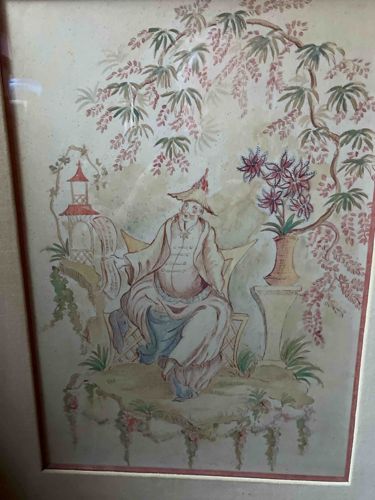
This watercolor painting depicts a scene in the Chinoiserie style, featuring a figure, likely an elderly man or scholar, in traditional East Asian attire, wearing a distinctive pointed hat with a red accent. The figure is seated on what appears to be a stone bench or rock formation in a garden setting, with an open scroll or book in their hands, suggesting an academic or contemplative pose. To the left of the figure is a red Chinese lantern, and to the right, a vase containing flowering plants, possibly chrysanthemums or similar blossoms, resting on a pedestal. Overhead, a large branch with green leaves and delicate pink or lavender wisteria blooms frames the upper part of the composition. The color palette employed is subtle, featuring muted greens, pinks, reds, and browns, with a dominant off-white or cream background that shows signs of age-related discoloration or foxing across the surface. The brushstrokes appear light and delicate, characteristic of watercolor techniques, with some ink outlines defining forms. The overall condition shows signs of age, including potential fading of colors and discoloration of the paper. Reflected light from the glass indicates that the painting is framed under glazing, though the frame itself is only partially visible and appears to be a simple, light-colored wood or composite material with a thin red border on the matting. No discernible artist's signature or specific manufacturing marks are visible in the provided images. Given the style, it likely dates from the late 19th to mid-20th century, a period when Chinoiserie remained popular in Western art and decor, though definitive dating would require further expert analysis of the paper and pigments.
AI Appraisal Report
Based on my visual examination of the image, this watercolor painting, "Chinoiserie Scene with Seated Figure and Wisteria," exhibits characteristics consistent with its described style and medium. The subtle color palette, delicate brushwork, and thematic elements align with Chinoiserie artwork popular from the late 19th to mid-20th century. The condition, as observed, shows signs of age, including apparent paper discoloration (foxing) and potential fading, which are common for watercolors of this vintage. The presence of a simple frame with a red border on the matting further suggests a period appropriate presentation.
Authenticity, based solely on visual images, is limited. While the style appears genuine for the Chinoiserie genre, confirming it as an authentic period piece would necessitate in-person examination. Specifically, I would need to assess the paper's watermark and fiber composition, analyze pigment stability and composition, and scrutinize the overall artistic hand for consistency with known period techniques. Absence of a discernible artist's signature is common for decorative Chinoiserie works, but it does impact value potential.
Market conditions for decorative Chinoiserie watercolors are generally stable, with a moderate demand driven by collectors and interior designers seeking period-specific accents. Rarity is not a significant factor here; while unique, Chinoiserie themes were widely produced. Factors significantly impacting value include the lack of a known artist, the condition issues (discoloration), and its likely decorative rather than fine art status. Without provenance documentation or a signature, the market value leans towards collectible decorative art rather than a significant individual artistic work.
For full authentication and a more precise valuation, a physical inspection is crucial to verify the paper's age and composition, analyze the pigments, and assess the true extent of discoloration and any restoration. Provenance documentation, if available, would significantly enhance authenticity and value.