These notes were written by the person who submitted this item. Appraiser.AI has not verified them, and the AI's identification and estimate may rely on them.
AI Estimated Value
Not an official valuation
$1,500 - $3,000
AI estimate as of September 3, 2025 · verify with a professional before acting
AI-Generated · Verify before acting
Everything on this page is generated by AI for informational purposes only. AI can make mistakes — the AI may misidentify items or misattribute them (artist, maker, brand, designer, origin, era). This is not an official valuation and should not be used for insurance, sale, tax, estate, legal, or lending purposes — or any decision requiring a certified appraisal. It is not an authoritative claim about any person, brand, or rights holder — do not share or rely on it as a factual statement about a third party. Always consult qualified professionals before making financial decisions.
This analysis also relies on unverified notes provided by the user, which may be incomplete or inaccurate and could affect the result.
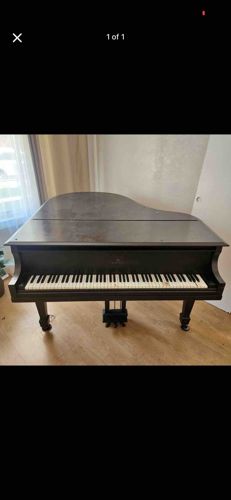
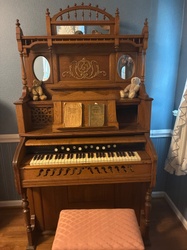
The item is a Kurtzmann baby grand piano, exhibiting a classic grand piano form factor. It features a dark, likely mahogany or walnut, wood finish, which appears to be a deep brown or black stain, possibly showing some fading or wear on the top surface. The piano has a traditional curved body typical of grand pianos, resting on four turned legs, each fitted with what appear to be original casters for mobility. The pedals are mounted on a central lyre-shaped support structure under the keyboard. The keyboard itself consists of white and black keys, standard for a piano, and appears to be in relatively good condition with no immediately visible chips or severe discoloration. The Kurtzmann logo or name is visible above the keys, centered on the fallboard. The overall style suggests an early to mid-20th-century manufacturing period, consistent with the history of the Kurtzmann piano company. Visible condition issues include what looks like dust and minor surface wear on the top lid, but no major structural damage or deep scratches are discernible from the image. The craftsmanship appears solid, as is expected of a vintage grand piano, with well-formed curves and sturdy leg construction. The finish has a slightly matte appearance, indicating it might be an older type of lacquering or varnish that has aged.
AI Appraisal Report
Based on my visual examination of the provided image, this Kurtzmann baby grand piano appears to be a good example of the craftsmanship from the early to mid-20th century, consistent with the company's historical period. The classic grand piano form, dark wood finish (likely mahogany or walnut), and traditional turned legs with casters are all typical features. The visible Kurtzmann name on the fallboard provides initial authentication of the brand.
From the image, the overall condition appears fair to good. I observe no major structural damage, large chips, or severe cracking. There is visible dust and minor surface wear on the lid, suggesting it has not been recently polished or regularly maintained, but this is superficial. The keys seem relatively intact with no immediate signs of severe discoloration or damage. The integrity of the internal components, such as the soundboard, pin block, strings, and hammers, cannot be assessed from an image, which significantly impacts the playability and true value of any piano. Market conditions for vintage baby grand pianos like this are generally moderate. While there's a niche market for historically significant or high-end restored instruments, models like this Kurtzmann typically appeal to those seeking an affordable grand piano for home use or as a decorative piece. Demand for these specific vintage makes is not exceptionally high, and they are not considered rare.
Key factors impacting value include the unconfirmed internal condition (which often necessitates costly repairs), the cosmetic wear, and the age. Without a full internal inspection, regulation, and tuning, the playable value is unknown. For full authentication and a more precise appraisal, an in-person examination by a qualified piano technician is essential. This would involve assessing the soundboard's integrity, pin block torque, string condition, hammer wear, and key action, as well as verifying the serial number for precise dating. Provenance documentation could also confirm its history. My current valuation is based purely on its perceived cosmetic and external structural condition, assuming typical internal wear for an instrument of this age.