AI estimate as of July 14, 2025 · verify with a professional before acting
AI-Generated · Verify before acting
Everything on this page is generated by AI for informational purposes only. AI can make mistakes — the AI may misidentify items or misattribute them (artist, maker, brand, designer, origin, era). This is not an official valuation and should not be used for insurance, sale, tax, estate, legal, or lending purposes — or any decision requiring a certified appraisal. It is not an authoritative claim about any person, brand, or rights holder — do not share or rely on it as a factual statement about a third party. Always consult qualified professionals before making financial decisions.
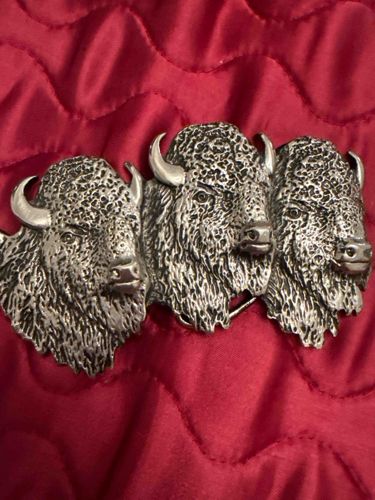
This item is a belt buckle featuring a horizontal relief sculpture of three American bison (buffalo) heads. The buckle appears to be made of a cast metal, likely a base metal such as pewter, tin alloy, or a silver-toned pot metal, given its metallic luster and the textured surface. It has a significant three-dimensional quality, with the buffalo heads rendered with considerable detail, particularly in their shaggy coats and distinct facial features. The 'fur' of the buffalo is depicted with a highly textured, stippled, or pebbled effect, contrasting with the smoother, polished appearance of their horns and parts of their faces. The eyes are recessed and well-defined, and the muzzles are sculpted with realistic dimension. The coloration is primarily a dark silver or pewter tone, with darker antiquing or oxidation in the recessed areas, which enhances the detail and gives the piece an aged or rustic patina. There are no immediately visible signs of significant damage such as dents, cracks, or large scratches, suggesting it is in good, used condition. The reverse side, where the belt loop and prong mechanism would be, is not visible, preventing assessment of manufacturing marks. This style of buckle, often depicting wildlife or Western themes, was particularly popular from the mid-20th century onwards, especially in the 1970s-1990s. The craftsmanship appears to be of a good commercial quality, with clear casting and defined details, indicating a mass-produced item rather than a unique artisan piece. The overall aesthetic suggests a connection to Americana, wildlife, or Western heritage.
AI Appraisal Report
Based on my visual examination of the provided image, this Three Buffalo Heads Belt Buckle appears to be in good, used condition. I observe no significant damage such as dents, cracks, or large scratches. The detailed casting, particularly of the buffalo's fur and facial features, suggests good commercial quality. The antiquing in the recessed areas enhances the three-dimensionality and provides an appropriate rustic patina, consistent with the likely age and material. Authenticity, based solely on visual inspection, points to a mass-produced item rather than a unique artisan piece. Similar wildlife or Western-themed belt buckles, often made of base metals like pewter or pot metal, were highly popular from the 1970s through the 1990s. This item fits that common aesthetic and production style.
The market for such vintage mass-produced belt buckles is generally stable but not exceptionally strong for non-precious metals. Demand exists among collectors of Western Americana, belt buckle enthusiasts, or those seeking unique accessories. However, these items are not rare; many similar examples are readily available online and at flea markets. Factors significantly impacting value include the material (non-precious base metal), the lack of a known designer or manufacturer, and its mass-produced nature. Were it sterling silver, or signed by a highly regarded artisan, the value would be substantially higher.
My assessment of authenticity is limited to what is visible. For full authentication, an in-person examination would be crucial to determine the exact metal composition (e.g., specific gravity testing, XRF analysis), inspect the reverse side for manufacturer's marks or hallmarks, and assess the integrity of the belt loop and prong mechanism. Provenance documentation, though unlikely for an item of this nature, would further solidify its history. Without these, the assessment remains based on visual characteristics consistent with common vintage buckles.