These notes were written by the person who submitted this item. Appraiser.AI has not verified them, and the AI's identification and estimate may rely on them.
AI Estimated Value
Not an official valuation
$8,000-12,000
AI estimate as of September 3, 2026 · verify with a professional before acting
AI-Generated · Verify before acting
Everything on this page is generated by AI for informational purposes only. AI can make mistakes — the AI may misidentify items or misattribute them (artist, maker, brand, designer, origin, era). This is not an official valuation and should not be used for insurance, sale, tax, estate, legal, or lending purposes — or any decision requiring a certified appraisal. It is not an authoritative claim about any person, brand, or rights holder — do not share or rely on it as a factual statement about a third party. Always consult qualified professionals before making financial decisions.
This analysis also relies on unverified notes provided by the user, which may be incomplete or inaccurate and could affect the result.
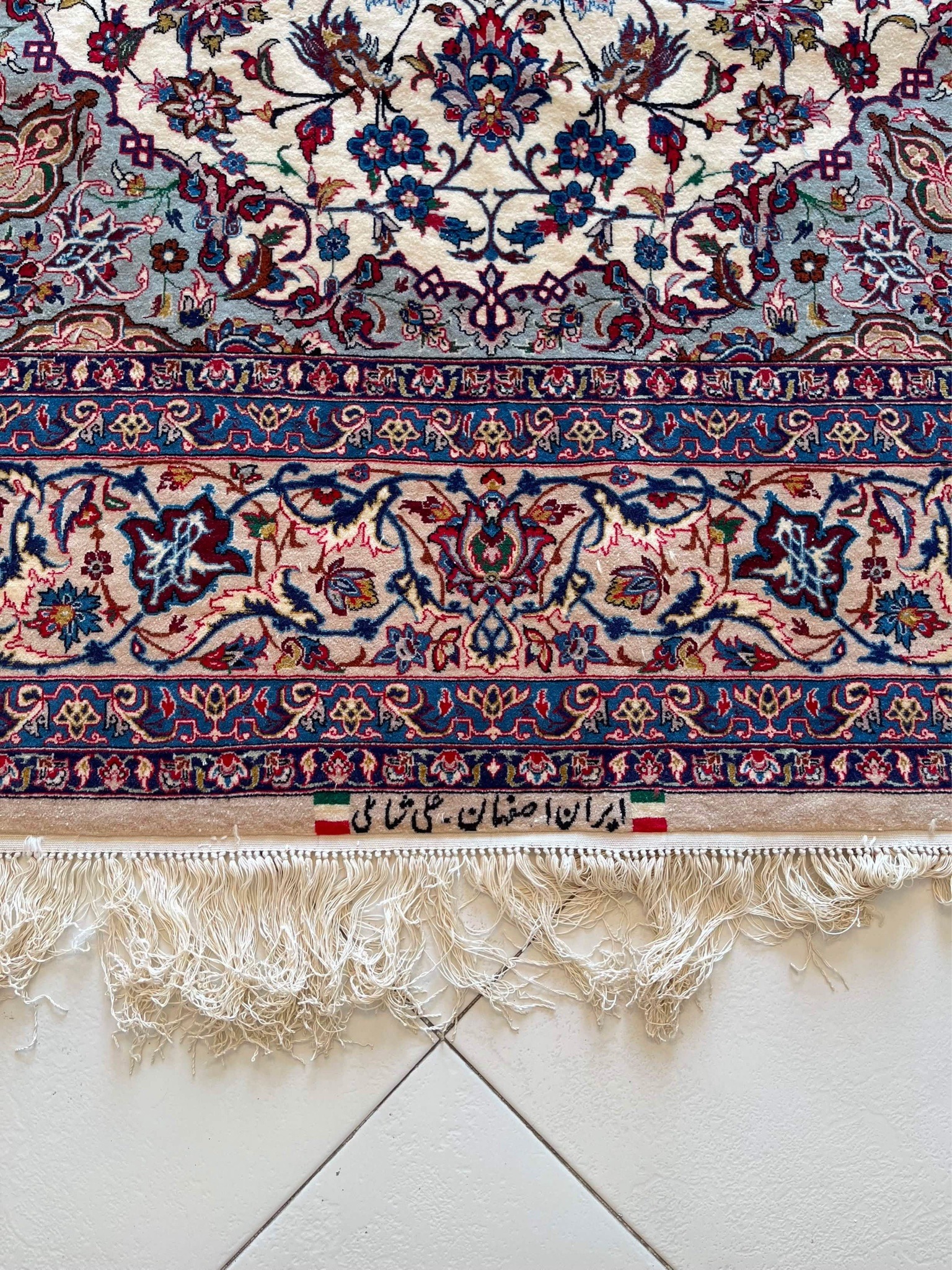
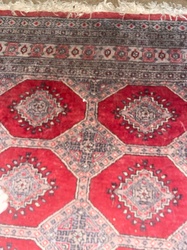
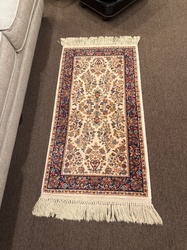
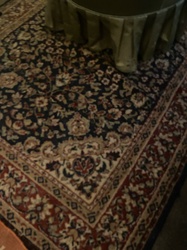
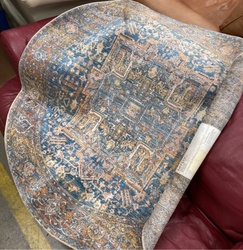
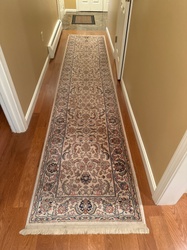
This detailed, finely knotted handwoven textile displays features consistent with a traditional Persian Isfahan carpet. The visual analysis reveals an intricate floral and scrollwork design featuring a rich palette of deep blues, rich reds, greens, and ivory cream accents. The construction exhibits a very high knot density, typical of fine Persian workshop craftsmanship. Along the lower border, a woven Persian inscription is clearly legible, reading 'ایران اصفهان علی شاملی' flanked by small motifs resembling the flag of Iran. The fringes at the end are knotted and appear consistent with traditional finishing techniques. The overall condition appears to be very clean with vibrant color retention and tightly packed pile. The attribution in the name rests upon the visibly woven signature text along the border, though the physical piece remains unauthenticated. Furthermore, the owner provides unverified context describing the piece as an Isfahan silk-foundation rug ('چله ابریشم اصفهان') attributed to Ali Shameli ('علی شاملی') with a 60-raj knot count density ('۶۰ رج'), which should be treated as unverified claims since physical inspection or material testing has not been performed to confirm the exact foundation fibers or density counts.
AI Appraisal Report
Based on the visual evidence available in the photograph, I observe a finely knotted handwoven carpet displaying features consistent with a traditional Persian Isfahan workshop piece, featuring an intricate floral scrollwork pattern, a rich color palette, and high apparent knot density. The lower border bears a woven inscription reading 'ایران اصفهان علی شاملی' alongside small motifs resembling the Iranian flag. Per user submission, the owner identifies this as an Isfahan silk-foundation rug attributed to Ali Shameli with a 60-raj knot count density. However, I cannot verify foundation fibers, exact knot counts, or material composition from a photograph alone, and physical inspection or material testing would be necessary to confirm these details. Furthermore, I must emphasize that the woven text serves only as a visible marking; it does not constitute a proven attribution or guarantee of authorship, as signatures can be replicated. My valuation range of $8,000-12,000 assumes that the attribution to the workshop of Ali Shameli is correct and that the materials and density match traditional high-grade Isfahan production. In the current market, fine Persian workshop carpets with exceptional detail and vibrant palettes generally attract steady interest from collectors of decorative arts, though values fluctuate based on condition and market demand. If physical inspection reveals the piece to be a modern reproduction, a lower-quality replica, or a work merely in the style of Isfahan weaving without the claimed silk foundation and fine knot density, the value would be significantly lower, likely falling into the $1,500-3,000 range. To establish a firm valuation, this rug would require an in-person physical examination by a textile expert, provenance documentation, and careful analysis of the foundation and knotting structure.