AI estimate as of September 26, 2025 · verify with a professional before acting
AI-Generated · Verify before acting
Everything on this page is generated by AI for informational purposes only. AI can make mistakes — the AI may misidentify items or misattribute them (artist, maker, brand, designer, origin, era). This is not an official valuation and should not be used for insurance, sale, tax, estate, legal, or lending purposes — or any decision requiring a certified appraisal. It is not an authoritative claim about any person, brand, or rights holder — do not share or rely on it as a factual statement about a third party. Always consult qualified professionals before making financial decisions.
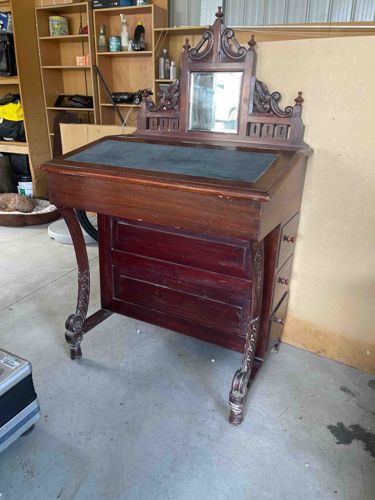
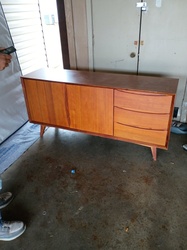
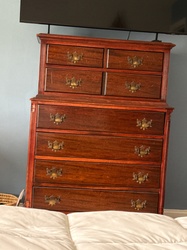
This is an antique secretary desk, likely dating from the late Victorian era (mid to late 19th century) given its elaborate carving and overall design. The desk is constructed primarily from a dark, rich wood, possibly mahogany or a similarly stained hardwood, exhibiting a deep reddish-brown hue. Physical characteristics include a sloped writing surface covered with what appears to be a dark green or black leather or felt insert, which likely lifts or folds to reveal storage compartments or a writing area. The desk is supported by highly ornate, carved legs or supports on the left side, featuring intricate scrollwork and possibly acanthus leaf motifs, curving inwards towards the base. The right side appears to be a solid cabinet structure incorporating a stack of small drawers, visible through the side view.
A prominent feature is the elaborate splashboard at the back of the writing surface, which includes a central rectangular mirror set within a highly decorative, carved wooden frame. The carving extends above and on either side of the mirror, featuring volutes, finials, and possibly stylized natural elements, characteristic of Victorian aesthetics. While the main body of the desk displays a generally good surface condition, there are visible signs of wear consistent with age and use, such as minor scratches, scuffs, and possibly some fading of the finish in areas. No major damage like cracks or breaks are immediately apparent from the image, but a comprehensive inspection would be needed. The craftsmanship appears to be of good quality, showcasing hand-carved details and solid joinery. The dark patina suggests original finish, contributing to its antique appeal. There are no visible maker's marks or signatures in the provided image.
AI Appraisal Report
Based on my visual examination of this Victorian Era Secretary Desk with Carved Mirror Splashboard, I assess its appraisal value to be between $1,200 and $1,800. This piece appears to be an authentic late Victorian era item, likely constructed from mahogany or a similar dense hardwood, exhibiting the characteristic elaborate carving and dark patina of the period. The sloped writing surface with an inset material and the combination of an intricate carved support on one side with a stack of drawers on the other are consistent with secretary desks from this era. The prominently featured carved mirror splashboard is a significant aesthetic highlight.
The condition appears generally good for its age, showcasing wear consistent with antique furniture, such as minor scratches, scuffs, and potential finish fading. Crucially, I see no immediate signs of major structural damage like cracks or breaks, suggesting it has been well-maintained or minimally restored. The craftsmanship, particularly the hand-carved details, enhances its appeal and value. Its dark, rich finish indicates original patination, which is desirable in the antique market.
Regarding market conditions, Victorian secretary desks with intricate carving and unique features like a mirrored splashboard typically command a fair price. While overall demand for large antique furniture can fluctuate, well-preserved pieces with artistic merit like this one retain a niche but consistent buyer base. Rarity is moderate; similar desks exist, but this specific configuration and quality of carving make it somewhat unique.
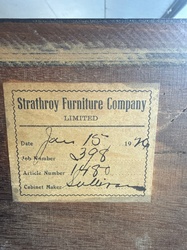
Factors impacting value include the solid construction, detailed carving, and good apparent condition. A comprehensive in-person inspection would be essential to confirm the wood species, assess the integrity of all joints, examine the condition of the writing surface material (leather vs. felt), and check for any repairs or hidden damage not visible in the image. Furthermore, physical examination could reveal any maker's marks, which would significantly aid in precise dating and potentially increase value. Without physical inspection, the authenticity of the material and construction methods can only be inferred from visual cues, and the absence of provenance documentation limits the ability to verify its history definitively.