AI Appraisal Estimate

AI-generated estimates · not official valuations

From the user

What was submitted

Photo and notes provided by the user — not generated by AI

Submitted item photo
Submitted photo · May 25, 2026

User's notes

James henry haseltine artist

AI analysis below

AI appraisal

AI analysis & estimate

AI-Generated · Verify before acting

Everything below is generated by AI for informational purposes only. AI can make mistakes — the AI may misidentify items or misattribute them (artist, maker, brand, designer, origin, era). This is not an official valuation and should not be used for insurance, sale, tax, estate, legal, or lending purposes — or any decision requiring a certified appraisal. It is not an authoritative claim about any person, brand, or rights holder — do not share or rely on it as a factual statement about a third party. Always consult qualified professionals before making financial decisions.

Note

This analysis also relies on unverified notes provided by the user, which may be incomplete or inaccurate and could affect the result.

Read the full disclaimer

AI Identification

·Not independently authenticated·Verify before acting

Neoclassical Marble Sculpture Fragment by James Henry Haseltine

Fine Art - Scuplture

AI Estimated Value

·Not an official valuation·Verify before acting

$6,000 - $9,000

As of May 25, 2026

AI Item Analysis

·AI can make mistakes·Verify before acting
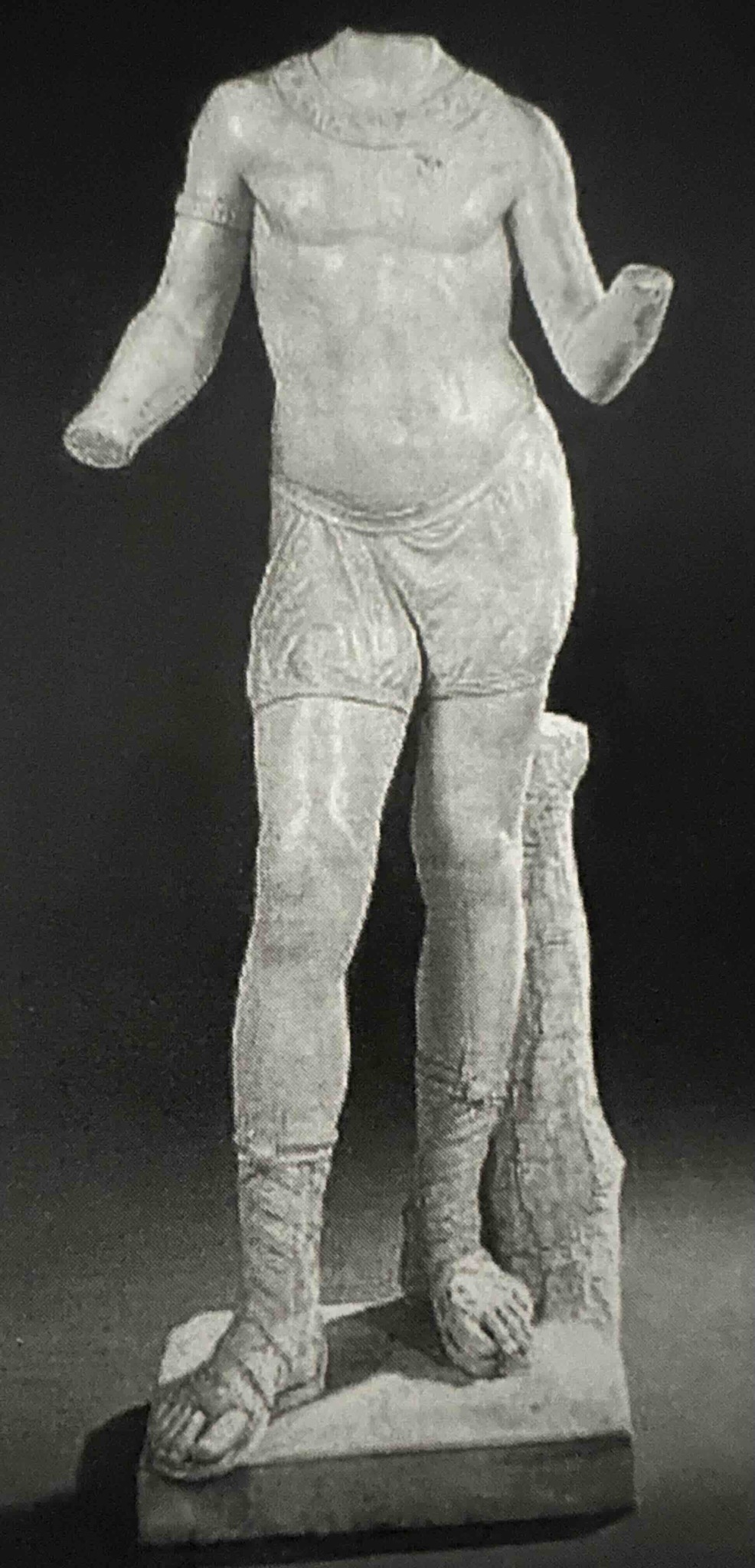
This is a life-sized Neoclassical marble sculpture depicting a male figure, attributed to the American sculptor James Henry Haseltine (1833–1907). The figure is portrayed in a classical 'contrapposto' stance, with weight shifted onto the left leg, creating a naturalistic curve through the torso. The piece displays a high level of academic proficiency in its anatomical execution, particularly in the subtle modeling of the abdominal muscles and the musculature of the legs. The figure is clad in elements suggestive of ancient Greco-Roman or mythological attire, including a decorative necklace or collar with repeating floral or geometric motifs, patterned shorts or a loincloth, an armband on the right bicep, and intricate lacing on the sandals (caligae style). The sculpture stands atop a rectangular integral plinth, supported by a tree-trunk-style strut behind the left leg—a common structural device in marble statuary to provide stability to the ankles. In terms of condition, the sculpture is currently a fragment: the head is missing at the neck line, and both arms terminate just below the shoulders, showing clean breaks that suggest structural loss over time. The surface of the stone appears monochromatic with a soft, matte patina consistent with aged white marble. There is visible wear on the toes and lower portions of the piece, though the detail in the garment drapery remains sharp. This work likely dates to the mid-to-late 19th century, a period when Haseltine, working in Rome and Nice, was heavily influence by Italian classical traditions and produced heroic and mythological figures for the American and European markets. The craftsmanship is characterized by smooth surface finishing and detailed textile rendering, indicative of high-quality professional studio work from the Neoclassical era.
AI Appraisal Report

·AI can make mistakes·Verify before acting
I have examined the digital representations of this life-sized Neoclassical marble sculpture attributed to James Henry Haseltine. The work displays the rigorous academic training and finish associated with his Roman period. The anatomical modeling of the iliac furrow and the intricate detailing of the 'caligae' footwear reflect a high degree of technical proficiency characteristic of American expatriate sculptors in the mid-19th century. Condition is the primary factor impacting value; the loss of the head and both arms significantly reduces the potential market or auction estimate compared to a complete figure. However, the survival of the torso and the integral plinth with its tree-trunk strut provides a compelling aesthetic that appeals to collectors of 'fragments' and classical ruins. The market for Haseltine is niche but stable, with complete heroic figures often reaching $20,000+, while fragments of this scale generally command mid-four-to-low-five-figure sums depending on the subject’s identification. While the stylistic markers align with Haseltine’s known repertoire, authentication via images alone is limited. A definitive attribution requires physical inspection of the marble's grain to confirm it is Carrara or a similar Italian quarry, and a search for signatures on the plinth reverse. In-person examination must look for any evidence of modern mechanical tool marks or chemical aging. To finalize verification, I recommend tracing provenance back to a specific commission or exhibition record and performing a comparative analysis of the decorative floral motif on the figure's collar against documented Haseltine works.

Get your items appraised

Instant estimates of your treasures with AI-powered appraisals

Browse More Appraisals