AI estimate as of July 18, 2025 · verify with a professional before acting
AI-Generated · Verify before acting
Everything on this page is generated by AI for informational purposes only. AI can make mistakes — the AI may misidentify items or misattribute them (artist, maker, brand, designer, origin, era). This is not an official valuation and should not be used for insurance, sale, tax, estate, legal, or lending purposes — or any decision requiring a certified appraisal. It is not an authoritative claim about any person, brand, or rights holder — do not share or rely on it as a factual statement about a third party. Always consult qualified professionals before making financial decisions.
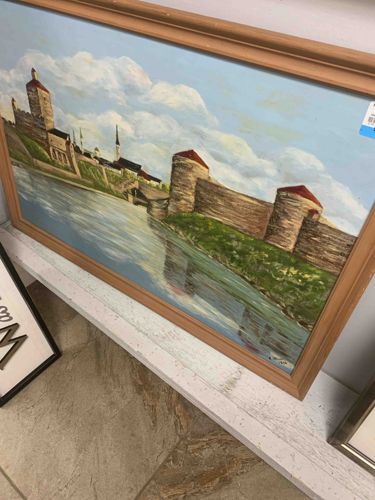
This is a framed, landscape-oriented painting, likely an oil or acrylic on canvas or board, depicting a European architectural riverscape. The painting features a fortified city or castle complex situated along a body of water, possibly a river or canal. On the left side of the composition, a prominent tall tower with a red roof, indicative of a castle or cathedral, stands atop a grassy embankment, surrounded by other smaller buildings and spired structures that form a townscape. On the right, a substantial stone wall with round defensive towers, also topped with red conical roofs, extends along the water's edge. The predominant colors are earthy browns and greys for the stone structures, varying shades of green for the grassy areas, a light blue for the water with reflections of the sky and buildings, and a clear blue sky filled with fluffy white clouds. The brushwork appears somewhat impressionistic or textured, particularly in the rendering of the clouds and the reflections in the water. The painting is housed in a simple, flat-profile wooden frame, possibly made of light-colored wood or stained a natural tone. A notable feature is the perspective, which places the viewer looking across the water towards the architectural elements. There is a blue tag, possibly a price tag or inventory tag, visible on the top right edge of the frame, indicating it may be from a retail or thrift environment. The overall condition appears good from the visible angle, with no obvious signs of significant damage, tears, or repairs to the canvas, or major chips/scratches on the frame. The style suggests it could be a mid-20th century piece or later, possibly a scenic souvenir painting. The craftsmanship appears to be of an amateur to semi-professional level.
AI Appraisal Report
Based on my visual examination of the provided image, this framed painting depicts a charming European riverscape. The piece, likely an oil or acrylic on canvas, is a decorative work by an unknown, likely amateur or semi-professional, artist. The style is somewhat impressionistic, capturing the scene with competent but not exceptional skill. The subject matter—a generic European castle scene—is a popular and very common theme in decorative art, often created for the tourist or decorator market.
The condition appears good from the photo, with no visible damage to the canvas or the simple wooden frame. However, the key factors limiting its value are its anonymity and presumed mass-market origin. Without a signature, provenance, or exhibition history, it is treated as decorative art. The market for such paintings is saturated; comparable unsigned, decorative European landscapes typically sell in secondary markets like auctions, estate sales, and online marketplaces for modest sums.
While the painting is pleasant, it lacks the rarity, artistic mastery, or historical significance that would command a higher price. This appraisal is strictly limited by the inability to conduct an in-person examination. A full authentication would require inspecting the back of the painting for signatures or labels, examining the canvas and stretcher for age, and potentially using UV light to check for repairs or overpainting. Without such steps, the work cannot be attributed to a specific artist or school, and its value remains at the decorative level.