AI estimate as of August 19, 2025 · verify with a professional before acting
AI-Generated · Verify before acting
Everything on this page is generated by AI for informational purposes only. AI can make mistakes — the AI may misidentify items or misattribute them (artist, maker, brand, designer, origin, era). This is not an official valuation and should not be used for insurance, sale, tax, estate, legal, or lending purposes — or any decision requiring a certified appraisal. It is not an authoritative claim about any person, brand, or rights holder — do not share or rely on it as a factual statement about a third party. Always consult qualified professionals before making financial decisions.
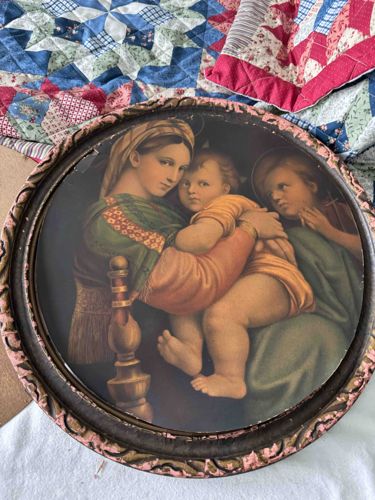
This item is a framed circular print, likely a reproduction of Raphael's 'Madonna della Seggiola' or 'Madonna of the Chair'. The print depicts the Virgin Mary holding the Christ Child, with Saint John the Baptist visible on the right. Mary is shown with a head covering, and all figures possess a serene expression. The colors appear somewhat muted, consistent with print reproductions of classical paintings. The print is housed within a circular wooden frame. The frame features a dark brown base color, possibly with a metallic gold or bronze undertone in the raised relief sections. Overlaid on top of this, or possibly as an original finish, are areas of chipped and distressed pink paint or gesso, giving it a somewhat shabby chic or aged appearance. The frame's inner edge next to the print is a plain, dark rim, while the outer edge has a decorative carved or molded pattern, now partially obscured by the pink and brown layers. The overall condition shows significant wear, particularly the frame, with extensive paint loss, chips, and visible distressing, indicating age and handling. The print itself appears to have some discoloration or fading, and potentially some surface scratching or minor imperfections, though these are less clear than the frame's condition. The overall construction suggests a mass-produced decorative item, likely from the mid-20th century, common as home decor featuring classical religious art.
AI Appraisal Report
After a thorough visual examination of the provided image, I've assessed this framed 'Madonna della Seggiola' print. The item is clearly a reproduction, likely mass-produced, given the print quality and the decorative, yet somewhat distressed, nature of the frame. The condition of the frame is poor, exhibiting extensive paint loss, chipping, and gesso damage, suggesting significant age and wear. The print itself shows signs of fading and potential surface imperfections, though these are less evident than the frame damage. Authenticity as an original Raphael is, of course, out of the question; this is a decorative art piece. Market conditions for such religious reproductions are generally low. These items were popular in the mid-20th century as home decor but hold limited collector value today unless tied to a significant provenance or artist, which is not the case here. Demand for common religious prints in distressed condition is sporadic and typically falls within a very low price bracket. The decorative, vintage aesthetic, despite the damage, might appeal to a niche 'shabby chic' buyer, but this doesn't significantly elevate its value. Factors impacting value negatively include its mass-produced nature, extensive condition issues, and lack of artistic originality. I cannot definitively date the print from the image alone nor assess the exact printing technique without physical inspection. An in-person examination would allow for a closer inspection of the print's surface for foxing, mold, or tears, and the frame's construction to confirm materials and potential manufacturer marks. Provenance documentation would be needed for any claim beyond a decorative item. Scientific testing, such as pigment analysis, is unnecessary given it's a reproduction.