These notes were written by the person who submitted this item. Appraiser.AI has not verified them, and the AI's identification and estimate may rely on them.
AI Estimated Value
Not an official valuation
$25-45
AI estimate as of November 22, 2025 · verify with a professional before acting
AI-Generated · Verify before acting
Everything on this page is generated by AI for informational purposes only. AI can make mistakes — the AI may misidentify items or misattribute them (artist, maker, brand, designer, origin, era). This is not an official valuation and should not be used for insurance, sale, tax, estate, legal, or lending purposes — or any decision requiring a certified appraisal. It is not an authoritative claim about any person, brand, or rights holder — do not share or rely on it as a factual statement about a third party. Always consult qualified professionals before making financial decisions.
This analysis also relies on unverified notes provided by the user, which may be incomplete or inaccurate and could affect the result.
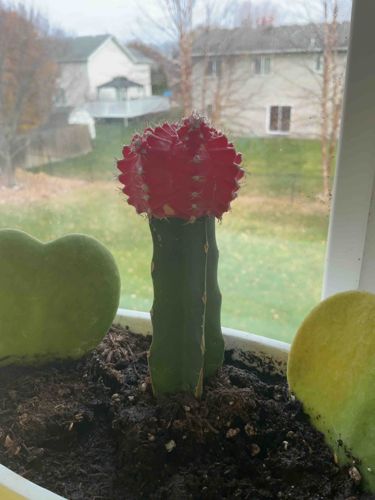
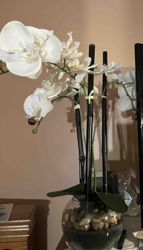
This item is a potted arrangement featuring a prominently positioned Moon Cactus (Gymnocalycium mihanovichii 'Hibotan') grafted onto a Hylocereus cactus stock, flanked by two Hoya Kerrii 'Sweetheart' leaves. The Moon Cactus scion, the top part, displays a vibrant, almost neon red coloration with visible ribs and small, short white spines or areoles scattered across its surface. It has a globular, slightly flattened shape with distinct segmentation. The grafting point with the green Hylocereus rootstock is clearly visible, showing a firm connection. The Hylocereus stock is a deep green, upright stem with visible ridges, providing support and nutrients to the colorful scion. To either side of the grafted cactus, two distinct Hoya Kerrii 'Sweetheart' leaves are planted directly into the soil. The leaf on the left is a healthy, solid green, heart-shaped succulent leaf, while the leaf on the right shows a gradient of color, transitioning from a bright yellow at its base to a lighter green as it extends outwards, potentially indicating variegation or early stages of discoloration. All plants are rooted in a dark, rich soil mixture that appears to be well-draining, containing small particulates, within a white rectangular planter that is largely obscured but visible at the edges. The overall composition suggests a decorative indoor plant display, likely grown for its aesthetic appeal. The condition of the plants appears generally healthy, with the exception of the potentially discolored Hoya leaf. No explicit manufacturing marks or signatures are visible, as these are living botanicals. The style is contemporary indoor gardening, suitable for a windowsill or bright interior spot. The craftsmanship is naturally occurring, with the grafting being a horticultural technique.
AI Appraisal Report
I have visually examined the provided image of this live plant arrangement, featuring a grafted Moon Cactus (Gymnocalycium mihanovichii 'Hibotan') on a Hylocereus stock, flanked by two Hoya Kerrii 'Sweetheart' leaves. Based on this visual assessment, the condition of the Moon Cactus and its Hylocereus rootstock appears healthy; the graft union seems sound, and the scion displays vibrant, characteristic coloration with distinct ribs. The green Hoya Kerrii leaf appears healthy, while the second Hoya leaf exhibits a yellowing gradient, which could indicate variegation but is more likely a sign of stress or early discoloration—a minor detractor. The dark potting medium suggests a suitable mix. This item is authentic as a live plant arrangement. Market conditions for such a combination of common, mass-produced succulents and cacti are generally stable, driven by aesthetic appeal for indoor decor. Comparables often sell in nurseries, garden centers, and online retailers. Demand for these individual plants is moderate to high, but due to their common availability and ease of propagation, they are not rare. Factors significantly impacting value include the health and vibrancy of the plants, the successful integration of the graft, and the aesthetic appeal of the overall arrangement within its planter. Without physical inspection, I cannot confirm the root health of all components, the presence of pests, or the precise composition of the potting medium. Further, the extent of variegation versus discoloration on the yellowing Hoya leaf cannot be definitively determined from imagery alone. Full authentication of plant species and health would ideally involve in-person examination by a horticultural expert.