AI estimate as of October 14, 2025 · verify with a professional before acting
AI-Generated · Verify before acting
Everything on this page is generated by AI for informational purposes only. AI can make mistakes — the AI may misidentify items or misattribute them (artist, maker, brand, designer, origin, era). This is not an official valuation and should not be used for insurance, sale, tax, estate, legal, or lending purposes — or any decision requiring a certified appraisal. It is not an authoritative claim about any person, brand, or rights holder — do not share or rely on it as a factual statement about a third party. Always consult qualified professionals before making financial decisions.
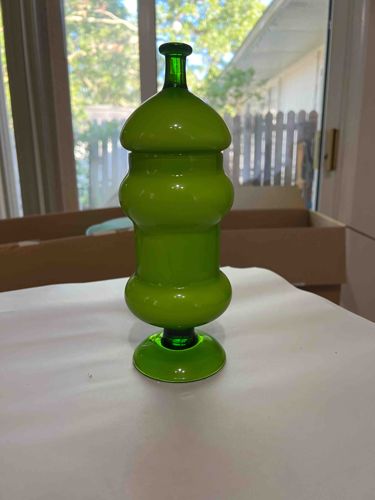
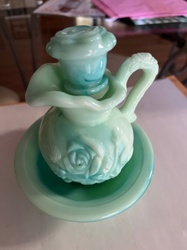
This item is a decorative cased art glass genie bottle with its original stopper, presented in a vibrant chartreuse green color. The bottle features a distinctive, undulating, multi-lobed or 'genie' shape, characterized by several rounded, bulbous sections that taper inward and then outward again along its vertical axis. The glass appears to be cased, meaning it has multiple layers of glass, giving it a rich, opaque, and luminous quality. The primary color is a striking translucent lime or chartreuse green, with an interior layer that might be white or clear, contributing to the depth of the color. The bottle stands on a circular, flared foot, providing stability and echoing the curves of the body. The stopper is designed to sit snugly into the bottle's neck, featuring a rounded, dome-like cap that mirrors the shape of the bottle's upper body, and a short, cylindrical neck that extends into the bottle opening. The overall aesthetic suggests a Mid-Century Modern design, likely from the 1960s or 1970s, a period known for bold colors and sculptural forms in glassware. There are no visible chips, cracks, or overt signs of significant damage or repair in the provided images, indicating good overall condition. The surface appears smooth and glossy, consistent with blown glass. No manufacturer's marks or signatures are discernible from the available photographs. The craftsmanship appears to be of good quality, with even color saturation and a well-formed, symmetrical shape.
AI Appraisal Report
Upon visual examination of the provided image, I assess this Chartreuse Green Cased Art Glass Genie Bottle with Stopper to be in very good to excellent vintage condition. There are no readily apparent chips, cracks, or repairs, and the surface appears smooth and glossy, consistent with well-preserved blown glass. The color saturation is even, and the form symmetrical, suggesting good craftsmanship.
This piece strongly aligns with Mid-Century Modern aesthetic trends, likely dating from the 1960s to 1970s. The vibrant chartreuse green color and 'genie' shape are characteristic of glassware from this period. While such cased glass bottles were popular, specific manufacturers like Empoli or Murano often produced high-quality examples. Without maker's marks or provenance, attributing it to a particular high-end studio is difficult. However, its attractive color, desirable form, and good condition contribute positively to its market appeal.
Demand for well-preserved Mid-Century Modern decorative glass remains strong, particularly for pieces that present as striking accents. Genie bottles, in general, enjoy a consistent collector base. This specific color and appealing shape create a desirable combination. While not exceptionally rare, a piece in this condition and style is not commonplace. The primary factors impacting value positively are its condition, appealing color, and classic MCM design. The absence of a discernible maker's mark or definitive attribution slightly limits its top-tier value.
My appraisal is based solely on the provided images. For full authentication and a more definitive appraisal, an in-person examination would be required to meticulously check for subtle flaws, internal cracking, manufacturing imperfections, and to potentially identify any faint marks not visible in photographs. Furthermore, provenance documentation or scientific testing (e.g., spectral analysis for glass composition) could definitively confirm its age and origin.