These notes were written by the person who submitted this item. Appraiser.AI has not verified them, and the AI's identification and estimate may rely on them.
AI Estimated Value
Not an official valuation
$75 - $125
AI estimate as of August 31, 2025 · verify with a professional before acting
AI-Generated · Verify before acting
Everything on this page is generated by AI for informational purposes only. AI can make mistakes — the AI may misidentify items or misattribute them (artist, maker, brand, designer, origin, era). This is not an official valuation and should not be used for insurance, sale, tax, estate, legal, or lending purposes — or any decision requiring a certified appraisal. It is not an authoritative claim about any person, brand, or rights holder — do not share or rely on it as a factual statement about a third party. Always consult qualified professionals before making financial decisions.
This analysis also relies on unverified notes provided by the user, which may be incomplete or inaccurate and could affect the result.
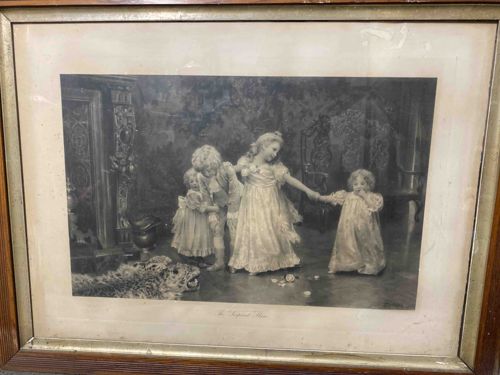
This is a framed monochrome art print, likely a photogravure or mezzotint, depicting a scene with four young children in what appears to be an opulent indoor setting. The print features a central group of three children, with a fourth, younger child to the far right, all seemingly engaged in play. The children are dressed in period attire, suggesting a Victorian or Edwardian style. The young girl in the center, wearing a light-colored dress, holds the hand of a smaller child to her right. Another child, possibly a boy, with curly hair, is positioned to the left of the central girl, bending over. In the foreground, on the floor, is a prominent depiction of a large, possibly taxidermied, wild cat, resembling a leopard or tiger, with its mouth open, adding a dramatic element to the scene. The background reveals ornate furniture, possibly a fireplace or carved wall paneling, and draped fabrics, indicating a wealthy interior. The print has a visible title "The Leopard Skin" or similar, inscribed at the bottom center. The overall condition of the print shows signs of age, including discoloration of the paper, particularly around the matting, and some visible spots or foxing consistent with moisture exposure or aging paper. The matting itself appears discolored and possibly deteriorating. The frame is a wooden, possibly oak, frame with a visible grain and some decorative carving or molding. The wood has a medium to dark stain, showing signs of wear and minor scuffs, consistent with an older piece. The glass covering the print shows some reflections but no major cracks are discernible. The style suggests a late 19th to early 20th century aesthetic, common for sentimental or illustrative prints of the era. The craftsmanship of the print itself appears to be of good quality for its type, with fine detail and tonal range evident despite the age and condition issues.
AI Appraisal Report
Upon my virtual examination of 'The Leopard Skin' framed art print, I assess it to be a late 19th to early 20th-century monochrome print, likely a photogravure or mezzotint, given the fine detail and tonal range. The subject matter, featuring children and a dramatic animal element, aligns with popular sentimental prints of that era. I note significant signs of age, including widespread discoloration of the paper and matting, particularly around the perimeter, and evident foxing. This suggests moisture exposure and acidic components in the framing materials, impacting the print's visual integrity. The condition issues significantly detract from its value. The wooden frame, possibly oak, exhibits wear, scuffs, and minor decorative molding, consistent with its age.
Authenticity, solely based on images, is challenging. While the style and condition appear consistent with the period described, an in-person examination would be crucial to confirm the printmaking technique (e.g., photogravure vs. a later photographic reproduction), paper type, and true extent of damage. A physical inspection would also allow for closer examination of the inscription 'The Leopard Skin' for its originality. Provenance documentation, though not provided, would be invaluable. Without physical examination, I cannot definitively rule out later reproductions, although the aesthetic aligns with period pieces.
Market comparables for similar aged, non-collectible decorative prints in this condition typically range on the lower end. Demand for such pieces is generally moderate, appealing more to those seeking period decor rather than fine art collectors, and rarity is not a factor. The print's condition, particularly the foxing and severe discoloration, is the most significant factor impacting value, reducing it from what a well-preserved example might fetch. Given these limitations and observations, I appraise this specific piece within the range of $75 - $125.