AI estimate as of June 23, 2025 · verify with a professional before acting
AI-Generated · Verify before acting
Everything on this page is generated by AI for informational purposes only. AI can make mistakes — the AI may misidentify items or misattribute them (artist, maker, brand, designer, origin, era). This is not an official valuation and should not be used for insurance, sale, tax, estate, legal, or lending purposes — or any decision requiring a certified appraisal. It is not an authoritative claim about any person, brand, or rights holder — do not share or rely on it as a factual statement about a third party. Always consult qualified professionals before making financial decisions.
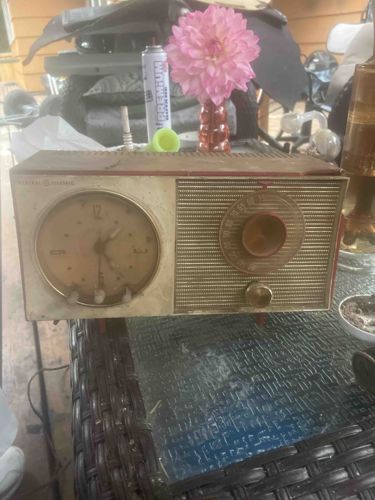
The item is a vintage General Electric clock radio, likely from the mid-20th century, possibly the 1950s or 1960s, given its design and apparent age. It features a rectangular form factor with a two-tone color scheme: an off-white or cream-colored main body, possibly bakelite or an early plastic, and a contrasting reddish-brown trim around the top edges. The front panel is divided into two distinct sections. On the left, a circular clock face with a cream background and dark numbers (12, 3, 6, 9 clearly visible) is housed behind a clear, but somewhat obscured, cover. The clock hands appear to be dark, likely black or brown. There are visible signs of wear and substantial dust or grime accumulation on the clock face and surrounding area, indicating age and lack of recent cleaning. The right side of the front panel features a rectangular speaker grille made of a metallic material, possibly brass or gold-painted aluminum, with a grid pattern. Centered within this grille is a larger, circular dial for tuning the radio, also in a reddish-brown color, with a smaller central knob. Below this, another smaller, round knob is visible, likely for volume or power. The entire unit exhibits significant dust and dirt, with some visible scratches and scuffs on the top surface. The reddish-brown trim also shows signs of fading or wear. There are no obvious maker's marks or model numbers immediately discernible from this image, other than "GENERAL ELECTRIC" printed above the clock face. The overall condition suggests a well-used item that has not been maintained, showing a heavy patina of age and exposure to dirt.
AI Appraisal Report
I have examined the image provided of this vintage General Electric clock radio, likely from the 1950s or 1960s. The item appears authentic as a General Electric product from that era, based on its design, visible branding, and material appearance (bakelite or early plastic). However, full authentication would require in-person inspection to verify internal components and manufacturing marks.The condition is poor. It exhibits significant dust, grime, visible scratches, and scuffs, especially on the top surface. The clock face is obscured by dirt, and the reddish-brown trim shows wear and fading. This heavy patina of age, while indicating authenticity, detracts significantly from its visual appeal and likely functionality. Market conditions for vintage clock radios of this type are generally moderate. While there is a niche collector market, common models in poor, unrestored condition typically do not fetch high prices. Comparables for similar GE clock radios in unrestored, dirty condition typically range from $20 to $60. Demand for such items is limited to enthusiasts or those seeking restoration projects. This particular model does not appear to be exceptionally rare.Factors significantly impacting value negatively include the extensive dirt and wear, and the unknown functional status. If the radio or clock mechanism is non-operational, its value diminishes further.Factors that would improve value, but are absent here, include excellent cosmetic condition, verified working condition, and original documentation or packaging. My valuation is based on its current visual condition as a collectible or restoration project.Without physical examination, I cannot confirm operational status, internal integrity, or the extent of any hidden damage. In-person inspection would allow for detailed functional testing, assessment of internal components for originality and condition, and thorough cleaning to reveal the true cosmetic state underneath the grime. Provenance documentation would be useful to establish its history, though less critical for an item of this type.