These notes were written by the person who submitted this item. Appraiser.AI has not verified them, and the AI's identification and estimate may rely on them.
AI Estimated Value
Not an official valuation
$10-15
AI estimate as of August 2, 2025 · verify with a professional before acting
AI-Generated · Verify before acting
Everything on this page is generated by AI for informational purposes only. AI can make mistakes — the AI may misidentify items or misattribute them (artist, maker, brand, designer, origin, era). This is not an official valuation and should not be used for insurance, sale, tax, estate, legal, or lending purposes — or any decision requiring a certified appraisal. It is not an authoritative claim about any person, brand, or rights holder — do not share or rely on it as a factual statement about a third party. Always consult qualified professionals before making financial decisions.
This analysis also relies on unverified notes provided by the user, which may be incomplete or inaccurate and could affect the result.
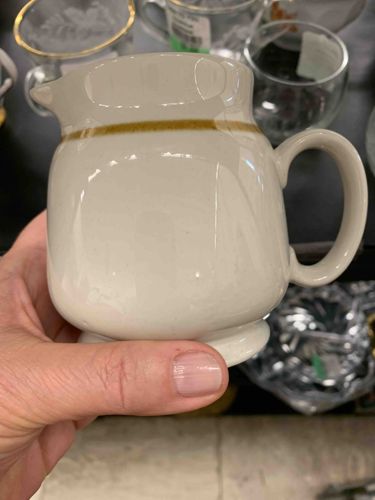
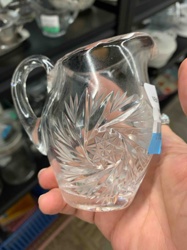
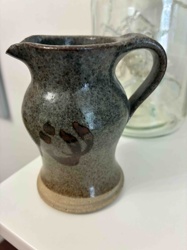
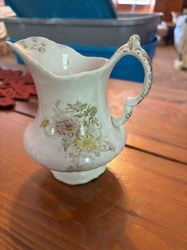
This item is a small, off-white stoneware creamer or small pitcher, held in a person's hand, giving a sense of its modest scale, likely ideal for serving cream, syrup, or individual portions of sauce. Its physical characteristics include a sturdy, slightly bulbous body that tapers gently towards a short neck and a subtle pouring spout. The primary color is an unblemished, matte off-white or light beige, which suggests a natural stoneware finish rather than a brightly glazed ceramic. A notable feature is a single, horizontal band of what appears to be a warm, earthy mustard yellow or light brown encircling the upper part of the body, just below the rim. This band adds a touch of rustic charm and visual interest to the otherwise plain design. The handle is a simple, C-shaped loop, integrated smoothly into the body, providing a comfortable grip. The base is not fully visible but appears to have a slight footed design, elevating the body slightly. The overall condition looks excellent, with no visible chips, cracks, or significant wear marks; the surface appears smooth and free from scuffs, indicating good preservation or minimal use. While no specific maker's marks or signatures are visible in the provided image, the 'Genuine stoneware Japan' context provided suggests it is a product of Japanese stoneware manufacturing. This type of stoneware often dates from the mid-20th century to the late 20th century, typically associated with a more minimalist or utilitarian design aesthetic. The craftsmanship appears to be robust and functional, consistent with durable everyday dinnerware. The clean lines and earthy tone indicate a timeless design, possibly fitting into a rustic, farm, or minimalist decor style.
AI Appraisal Report
Upon examining the images provided of this stoneware creamer, it presents as a well-preserved example of mid-to-late 20th-century Japanese export ware. The piece is characterized by its utilitarian design, featuring a simple, bulbous body, a matte off-white finish, and a distinctive mustard-colored band. The 'Genuine stoneware Japan' marking is consistent with mass-produced tableware from this era, aimed at the Western market. Its condition appears excellent from the photographs, with no visible chips, cracks, or crazing, which is a positive value factor. This style of rustic, minimalist stoneware has seen a resurgence in popularity due to its alignment with farmhouse and minimalist decor trends. However, the market for such items is saturated. A search for comparable 'Genuine Stoneware Japan' creamers or small pitchers on platforms like Etsy, eBay, and Replacements, Ltd. reveals many similar items. Their value is primarily functional and decorative rather than driven by rarity or a specific maker. The primary factor influencing its value is its aesthetic appeal and excellent condition, rather than any collectible rarity. Without a physical inspection, I cannot confirm the absence of hairline cracks or subtle crazing under the glaze which would affect value. A definitive authentication would require examining the piece for any specific manufacturer's marks not visible in the photo, and assessing the texture and weight of the stoneware firsthand.