AI estimate as of July 10, 2025 · verify with a professional before acting
AI-Generated · Verify before acting
Everything on this page is generated by AI for informational purposes only. AI can make mistakes — the AI may misidentify items or misattribute them (artist, maker, brand, designer, origin, era). This is not an official valuation and should not be used for insurance, sale, tax, estate, legal, or lending purposes — or any decision requiring a certified appraisal. It is not an authoritative claim about any person, brand, or rights holder — do not share or rely on it as a factual statement about a third party. Always consult qualified professionals before making financial decisions.
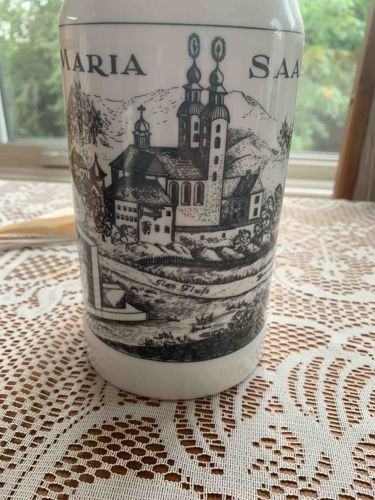
The item is a ceramic beer stein or mug, primarily white with a black and white transfer-printed panoramic scene. Its cylindrical body tapers slightly towards the top. The depicted scene appears to be a landscape featuring a prominent historical building, likely a church or monastery, nestled within a hilly or mountainous terrain. The building itself is intricately detailed, showcasing multiple spires, arched windows, and what looks like a cross atop one of its structures. Surrounding the building are trees and what might be a body of water or road in the foreground, labeled 'Glas Fluß' (Glass River). The upper portion of the mug features text: 'MARIA' on the left and 'SAA' on the right, suggesting 'Maria Saal' which is a known pilgrimage church in Austria. The printing quality is good, with fine lines and clear details characteristic of historical topographical prints. The mug shows no obvious signs of chips, cracks, or significant wear; the glaze appears intact and glossy. The general aesthetic points towards a souvenir item, likely from the mid-to-late 20th century, due to the style of the transfer print and the commonality of such souvenir items. The craftsmanship appears to be standard for mass-produced ceramic wares of that period, focusing on decorative appeal rather than intricate hand-painted details. The base is simple and unadorned, typical of a sturdy drinking vessel.
AI Appraisal Report
Upon visual examination of the provided image, this ceramic mug/stein appears to be a souvenir item from Maria Saal, Austria. The transfer print depicts a detailed panoramic scene featuring the pilgrimage church, consistent with such topographical souvenirs. The condition appears to be excellent; the glaze is intact and glossy, and there are no discernible chips, cracks, or significant wear visible from the image. This suggests good preservation for an item likely intended for daily use or display.
Authenticity, based on visual evidence alone, is challenging to fully verify. The style of the transfer print and the overall construction are consistent with mass-produced ceramic souvenir items from the mid-to-late 20th century. While the 'Maria Saal' labeling is clear, confirming the manufacturer, precise age, and origin would require physical inspection for maker's marks or backstamps, which are not visible in the image. An in-person examination would also allow for a tactile assessment of the ceramic body and glaze, and confirm the absence of subtle flaws not apparent in photographs.
Market conditions for souvenir steins of this type are generally stable but do not command high prices unless associated with a particularly significant event, rare design, or a highly sought-after manufacturer. Comparables usually include similar-era European tourist mugs. Demand is typically niche, appealing primarily to collectors of regional memorabilia or steins. This item is not rare; similar souvenir pieces were produced in large quantities. Factors impacting value are primarily condition (excellent here), and the specific appeal of Maria Saal to potential buyers, which is moderately known. Without physical examination, provenance documentation confirming its history, or specific manufacturing details, the potential for a higher valuation is limited.
For full authentication and a more precise valuation, a physical inspection to check for maker's marks, glaze imperfections, and overall structural integrity would be crucial. Research into similar Maria Saal souvenirs from the likely production period would also aid in establishing rarity and specific market demand.