AI Appraisal Estimate

AI-generated estimates · not official valuations

From the user

What was submitted

Photo and notes provided by the user — not generated by AI

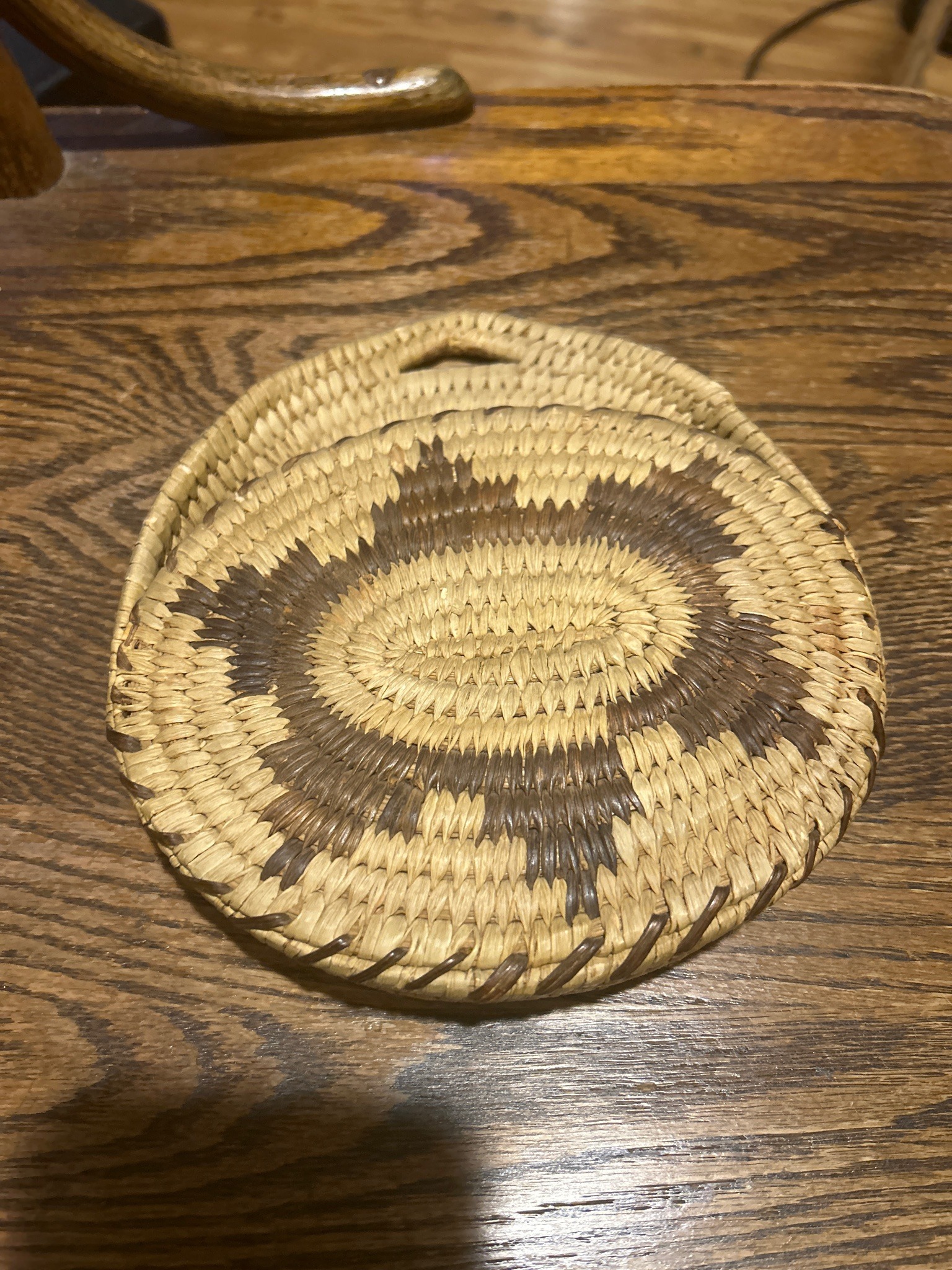
Submitted item photo
Submitted photo · July 21, 2026

User's notes

No additional notes provided.

AI analysis below

AI appraisal

AI analysis & estimate

AI-Generated · Verify before acting

Everything below is generated by AI for informational purposes only. AI can make mistakes — the AI may misidentify items or misattribute them (artist, maker, brand, designer, origin, era). This is not an official valuation and should not be used for insurance, sale, tax, estate, legal, or lending purposes — or any decision requiring a certified appraisal. It is not an authoritative claim about any person, brand, or rights holder — do not share or rely on it as a factual statement about a third party. Always consult qualified professionals before making financial decisions.

Read the full disclaimer

AI Identification

·Not independently authenticated·Verify before acting

Coiled woven trivets or mats in the South Pacific or Native American style

Handmade Textiles and Basketry

AI Estimated Value

·Not an official valuation·Verify before acting

$40.00 - $125.00

As of July 21, 2026

AI Item Analysis

·AI can make mistakes·Verify before acting
This pair of circular items appears to be hand-woven trivets or small decorative mats, featuring a coiled construction technique. The material is consistent with natural plant fibers such as sweetgrass, raffia, or pine needles, displaying a light natural tan base with dark brown dyed fibers used to create geometric patterns. The top mat shows a concentric tiered design with serrated or stepped edges on the dark motifs, suggesting a style consistent with traditional weaving from regions such as the American Southwest (Hopi or Navajo-style) or the South Pacific, though without physical inspection of the start and finish of the coils, a specific origin remains a hypothesis. The pieces measure several inches in diameter and appear to have a slight depth or edge rim. The back piece features a small integrated loop, appearing to be for hanging display. The stitching is tight and even, indicating skilled craftsmanship. Condition-wise, the fibers appear well-preserved with no visible fraying, breaking, or significant fading, though there is a slight natural variation in the color consistent with organic materials. No maker's marks, signatures, or labels are visible; the identification depends entirely on the visual construction and stylistic decorative elements. Expert in-person tribal arts authentication would be required to determine if these are mid-20th-century artisanal works or contemporary decorative reproductions.

AI Appraisal Report

·AI can make mistakes·Verify before acting
Based on my visual examination of the provided images, these two coiled woven mats appear to be skillfully crafted textiles utilizing natural plant fibers. The construction features a tight, rhythmic stitching pattern and geometric motifs that are stylistically consistent with indigenous weaving traditions from the American Southwest or potentially certain South Pacific regions. From what I can see, the pieces are in excellent vintage condition, showing minimal fiber degradation or fading. However, I cannot verify the exact age, material composition, or tribal origin from a photograph alone. I am treating the attribution to a specific indigenous group as a hypothesis only, as modern decorative reproductions often replicate these traditional patterns with high fidelity. My value estimate is based on the assumption that these are mid-20th-century artisanal works. In the current market, there is steady demand for hand-woven tribal arts, particularly those with strong geometric contrast and functional utility. If these items are confirmed through in-person inspection to be early-to-mid-20th-century Hopi or Tohono O'odham basketry, the value could reach the higher end of the spectrum or beyond. Conversely, if physical examination of the coil starts/terminations or fiber prep suggests they are contemporary mass-produced imports 'in the style of' traditional weaving, the value would likely drop to $15-$30 for the pair. To provide a more precise valuation, a physical inspection by a specialist in basketry is necessary to evaluate the 'stip' and 'fag' ends of the stitches and the specific botanical nature of the fibers, which are key indicators of geographic origin and age.

Related Tags

Explore similar items and categories

Get your items appraised

Instant estimates of your treasures with AI-powered appraisals

Browse More Appraisals