AI estimate as of October 8, 2025 · verify with a professional before acting
AI-Generated · Verify before acting
Everything on this page is generated by AI for informational purposes only. AI can make mistakes — the AI may misidentify items or misattribute them (artist, maker, brand, designer, origin, era). This is not an official valuation and should not be used for insurance, sale, tax, estate, legal, or lending purposes — or any decision requiring a certified appraisal. It is not an authoritative claim about any person, brand, or rights holder — do not share or rely on it as a factual statement about a third party. Always consult qualified professionals before making financial decisions.
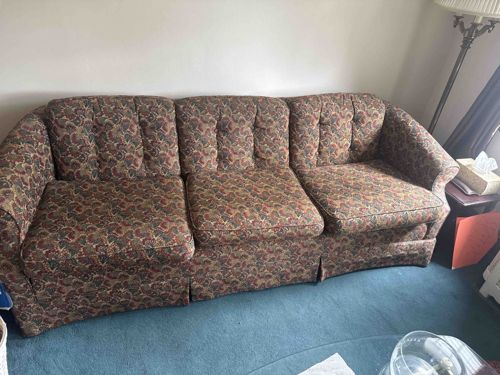
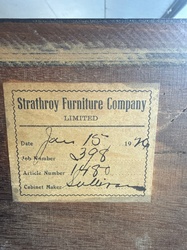
This is a vintage three-seater sofa, upholstered in a traditional paisley patterned fabric. The physical characteristics indicate a substantial piece of furniture designed for comfort and durability. The upholstery features a complex and somewhat faded color palette, primarily incorporating shades of brown, beige, muted red, dark green, and a subtle blue, creating an intricate floral or teardrop motif throughout. Each of the three back cushions is individually tufted, creating vertical pleats that add a decorative element and contribute to the structured appearance of the backrest. The seat cushions are loose, rectangular, and fairly thick, suggesting a comfortable seating experience. The arms are rolled, a classic design feature, and are covered in the same paisley fabric. The sofa rests on a fabric skirt or kick pleat, which conceals the legs, giving it a more formal and traditional aesthetic. Visible condition issues include some general wear consistent with age and use, such as minor fading in the upholstery and potential compression of the cushions. Manufacturing details are not visible from the provided images, so no maker's marks or signatures can be identified. Based on the upholstery pattern, tufted back, rolled arms, and skirted base, this sofa likely dates from the mid-to-late 20th century, possibly the 1970s or 1980s, reflecting a traditional or transitional style period. The overall craftsmanship appears solid, typical of domestic furniture from that era, prioritizing comfort and a somewhat ornate aesthetic.
AI Appraisal Report
I have examined the provided image of this vintage three-seater sofa with paisley upholstery. Visually, the sofa presents as a substantial piece of domestic furniture, likely originating from the mid-to-late 20th century, consistent with the styles popular in the 1970s or 1980s. The traditional design elements, including rolled arms, a tufted back, and a skirted base, alongside the intricate paisley pattern, strongly support this dating.
From the image, the condition appears consistent with its age and use. I observe general wear, including some fading of the multi-toned paisley upholstery, which is expected for an item of this vintage. There may be some compression in the loose seat cushions, although this is difficult to ascertain definitively without physical inspection. The overall craftsmanship appears solid, suggesting decent durability.
Market conditions for vintage sofas of this era and style are generally moderate. While there is a niche market for well-preserved vintage furniture, traditional patterned upholstery, particularly paisley, can be a polarizing factor influencing demand. Comparables in similar condition often fetch values in the lower to mid-hundreds, particularly when no prominent maker is identified.
Factors significantly impacting value here include the faded upholstery, which aesthetic preferences vary widely for, and the lack of visible maker's marks. Without knowing the manufacturer, it's difficult to assess potential collectible value. The solid but somewhat unassuming aesthetic limits its appeal as a high-design collectible.
It is crucial to note that my assessment of authenticity and condition is based solely on visual examination of the image. A physical inspection would be essential to confirm upholstery integrity, frame stability, cushion density, and to search for any concealed maker's marks or provenance documentation. This would allow for a more precise assessment of its structural integrity and potential manufacturing origin, which could impact its value. I did not see any obvious red flags regarding authenticity, but further verification, including potential fabric testing for material composition if deeper historical analysis were required, would necessitate an in-person examination.