AI estimate as of November 11, 2025 · verify with a professional before acting
AI-Generated · Verify before acting
Everything on this page is generated by AI for informational purposes only. AI can make mistakes — the AI may misidentify items or misattribute them (artist, maker, brand, designer, origin, era). This is not an official valuation and should not be used for insurance, sale, tax, estate, legal, or lending purposes — or any decision requiring a certified appraisal. It is not an authoritative claim about any person, brand, or rights holder — do not share or rely on it as a factual statement about a third party. Always consult qualified professionals before making financial decisions.
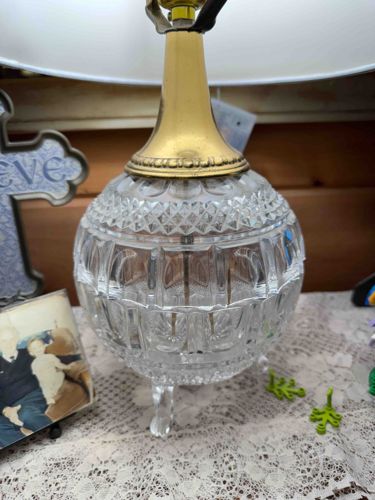
This is a vintage table lamp featuring a spherical body crafted from clear, cut glass, topped with a brass neck and a white lamp shade (partially visible). The spherical glass body exhibits intricate facet-cut patterns, transitioning from a diamond-cut, cross-hatch design on the upper hemisphere to vertical fluting or ribbing with stylized star or leaf motifs at the base. The glass appears to be of good quality, showing a high degree of clarity and refractiveness. The lamp stands on three clear glass feet, subtly integrated into the bottom of the spherical body, suggesting a delicate yet stable base. The brass neck connecting the glass body to the light socket and shade holder is conical, tapering upwards, and displays a warm, aged patina consistent with brass that has not been recently polished. Along the base of the brass neck, where it meets the glass, there is a decorative band with a textured or beaded edge, adding to its ornate appearance. The white lamp shade is only partially visible at the top, implying a traditional barrel or bell shape. There are no visible chips, cracks, or significant damage to the glass body, and the brass shows no obvious dents or heavy corrosion, only natural aging. The electrical components (cord, plug, switch) are not fully visible but would be important for assessing functionality and safety. The overall aesthetic suggests a late 19th to early 20th-century design, possibly Art Deco or Victorian revival, characterized by its decorative opulence and blend of materials.
AI Appraisal Report
This Vintage Cut Glass and Brass Table Lamp presents as a charming decorative piece, likely dating from the late 19th to early 20th century, with design elements reminiscent of Victorian or early Art Deco styles. Based on the provided image, the spherical cut glass body appears to be in excellent condition, with no visible chips, cracks, or significant damage. The intricate facet-cut patterns, including the diamond-cut cross-hatch and fluted designs, suggest quality craftsmanship. The brass components, including the neck and decorative band, exhibit a pleasing, aged patina consistent with their presumed age, with no obvious signs of heavy corrosion or dents. The three clear glass feet are well-integrated and appear intact.
From a visual perspective, the overall condition is very good, which positively impacts its market value. The combination of cut glass and brass is a desirable aesthetic for collectors of antique and vintage lighting. Demand for such pieces is generally steady among interior designers and individuals seeking period-appropriate decor. Comparables often fall within this price range for well-preserved examples.
However, it is crucial to note the limitations of an image-only appraisal. Authenticity of period and origin cannot be definitively confirmed without physical inspection. I would need to examine the electrical components (cord, plug, socket, switch) for originality, safety, and functionality, as rewiring or replacement can affect value. A close examination of the glass for manufacturing marks, and the brass for specific maker's marks or construction techniques, would be invaluable. While the design is compelling, true rarity hinges on definitive attribution or unique features not apparent here. Without provenance documentation or a hands-on examination to confirm materials, construction, and electrical integrity, the upper end of the valuation remains conservative.