AI Appraisal Estimate

AI-generated estimates · not official valuations

From the user

What was submitted

Photo and notes provided by the user — not generated by AI

Submitted item photo
Submitted photo · May 19, 2026

User's notes

Haida bracelet

AI analysis below

AI appraisal

AI analysis & estimate

AI-Generated · Verify before acting

Everything below is generated by AI for informational purposes only. AI can make mistakes — the AI may misidentify items or misattribute them (artist, maker, brand, designer, origin, era). This is not an official valuation and should not be used for insurance, sale, tax, estate, legal, or lending purposes — or any decision requiring a certified appraisal. It is not an authoritative claim about any person, brand, or rights holder — do not share or rely on it as a factual statement about a third party. Always consult qualified professionals before making financial decisions.

Note

This analysis also relies on unverified notes provided by the user, which may be incomplete or inaccurate and could affect the result.

Read the full disclaimer

AI Identification

·Not independently authenticated·Verify before acting

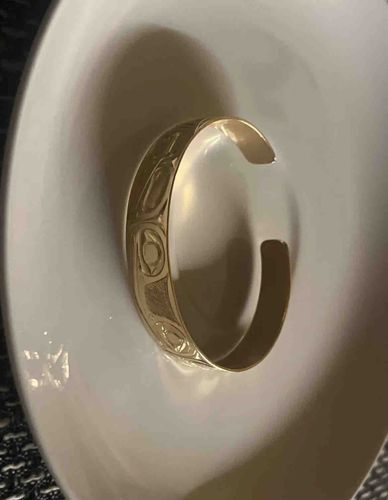
Haida Gold Formline Engraved Cuff Bracelet

Fine Jewelry / Indigenous Northwest Coast Art

AI Estimated Value

·Not an official valuation·Verify before acting

$4,500 - $6,500

As of May 19, 2026

AI Item Analysis

·AI can make mistakes·Verify before acting
This is a finely crafted Northwest Coast Haida-style cuff bracelet, appearing to be constructed from high-carat yellow gold based on the deep, rich hue and luster. The piece features traditional Haida formline engraving, a sophisticated art style involving ovoids, U-shapes, and S-shapes to represent crest figures or mythological beings. The engraving shows significant depth and precision, with cross-hatched or textured backgrounds used to provide contrast against the polished raised elements. The cuff is of a medium width, featuring rounded terminals for comfortable wear. Its construction is solid rather than plated, indicated by the thickness of the metal at the edges. Regarding condition, the metal displays a soft patina with minor surface micro-abrasions consistent with gentle handling; there are no visible deep gouges, bends, or structural repairs. The interior surface appears smooth and highly polished. The craftsmanship suggests a skilled artisan proficient in Northwest Coast indigenous jewelry traditions, likely dating from the late 20th century to the contemporary period. No visible maker's mark is discernible from this angle, though such pieces are often signed on the interior. The uniform curvature and clean engraving lines indicate a high-quality hand-carved piece of significant cultural and intrinsic value.
AI Appraisal Report

·AI can make mistakes·Verify before acting
I have carefully examined the provided images and descriptions of this Northwest Coast Haida-style gold cuff. Based on the deep luster and uniform color, the piece appears to be 14k or 18k yellow gold. The engraving demonstrates an exceptional mastery of formline design; the precision of the ovoids and the use of fine cross-hatching for dimensionality are hallmarks of a master-level artisan. The condition is excellent, showing only light surface wear commensurate with a well-maintained estate piece. The market for Indigenous Northwest Coast gold jewelry remains robust, with high demand for pieces that exhibit traditional motifs like the eagle, raven, or bear. Comparable works by recognized Haida artists (such as those in the lineage of Bill Reid or Robert Davidson) regularly command premium prices at specialized auctions and galleries. The intrinsic value of the gold provides a baseline, but the 'artistic premium' accounted for in this valuation is significant due to the hand-carved nature of the work. However, this appraisal is subject to several professional limitations. Without a physical inspection, I cannot verify the gold purity via acid or XRF testing, nor can I confirm the exact weight, which is critical for valuation. Most importantly, the absence of a visible maker’s mark in the images prevents attribution to a specific artist—a factor that could double the value if linked to a renowned master. Full authentication requires an in-person examination of the interior for hallmarks, a physical weight measurement, and a review of provenance or original gallery documentation to confirm the piece's origin and the artist’s identity.

Get your items appraised

Instant estimates of your treasures with AI-powered appraisals

Browse More Appraisals