AI estimate as of October 1, 2025 · verify with a professional before acting
AI-Generated · Verify before acting
Everything on this page is generated by AI for informational purposes only. AI can make mistakes — the AI may misidentify items or misattribute them (artist, maker, brand, designer, origin, era). This is not an official valuation and should not be used for insurance, sale, tax, estate, legal, or lending purposes — or any decision requiring a certified appraisal. It is not an authoritative claim about any person, brand, or rights holder — do not share or rely on it as a factual statement about a third party. Always consult qualified professionals before making financial decisions.
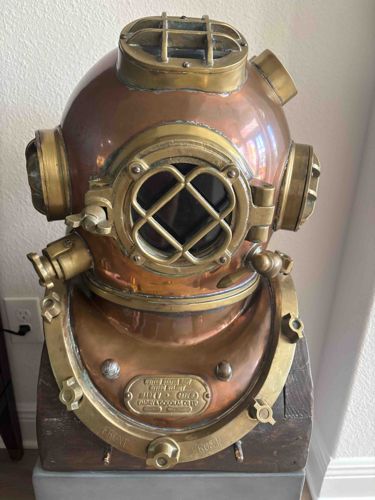
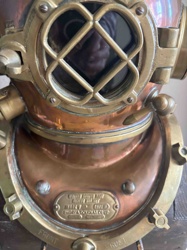
This is an antique deep-sea diving helmet, likely a replica or display piece given its condition and lack of significant wear/tear for an original working helmet. It features a robust construction primarily of polished copper for the main body of the helmet and corselet, beautifully contrasting with brass components including the circular front viewport, side port windows, top air intake, and securing mechanisms. The front viewport is protected by a brass grid, indicating potential use or reproduction of a helmet designed for hazardous underwater conditions. Various brass fixtures, such as what appear to be air inlet/outlet valves and securing nuts, are visible around the helmet and corselet. The corselet, the lower part that rests on the diver's shoulders, has a brass rim with visible turn-to-tighten knobs and is mounted on a wooden base, possibly original to the piece or added for display. A prominent brass plate, likely a manufacturer's plaque or informative label, is affixed to the front of the corselet, though its specific inscription ('CROSBY CO' is partially legible) remains unclear without a clearer image, which could significantly impact its provenance and value. The copper shows a rich, warm patina with some areas of darker oxidation and minor surface blemishes, consistent with age and exposure, but generally well-maintained. The brass elements exhibit a bright, slightly tarnished finish typical of aged brass. Visually, the helmet appears to be in very good condition, suggesting it has been preserved as a decorative item rather than experiencing the rigors of actual deep-sea use. The craftsmanship appears high, with carefully riveted and soldered seams, indicating a quality construction. The style points to an era of traditional deep-sea diving equipment, likely late 19th to early 20th century in design, possibly representing a U.S. Navy or commercial diving helmet of that period.
AI Appraisal Report
Based on my visual examination of the provided image, this antique deep-sea diving helmet presents as a high-quality replica or display piece rather than a working original. Its excellent condition, with minimal wear for a functional helmet, strongly suggests it was produced for decorative purposes. The polished copper and brass components are well-maintained, exhibiting an attractive patina consistent with age and careful preservation. The visible 'CROSBY CO' on the plaque is intriguing, as Crosby Marine was a real manufacturer; however, without a clearer image or physical inspection, I cannot confirm if this is an authentic manufacturer's plaque or a reproduction detail.
Market conditions for original deep-sea diving helmets vary widely, often reaching tens of thousands of dollars. Replicas, while retaining aesthetic appeal, command significantly lower prices. Comparables for high-quality replicas or re-creations in similar materials and condition typically fall into the $1,500-$3,000 range, depending on the craftsmanship and perceived age. Demand for decorative maritime equipment is relatively stable among collectors and interior designers. The perceived age and quality craftsmanship contribute positively to its value, despite likely being a replica.
The primary factor impacting value here is authenticity. While visually impressive, definitive authentication without physical inspection is impossible. To fully confirm authenticity and provenance, I would need an in-person examination to inspect internal components, material composition, soldering techniques, and any hidden markings. Documentation of its history, original purchase, or expert examination reports would also be crucial. Spectrographic analysis of the metals could further aid in dating. Without these, my valuation reflects its strong decorative appeal and assumed replica status.