AI Appraisal Estimate

AI-generated estimates · not official valuations

From the user

What was submitted

Photo and notes provided by the user — not generated by AI

Submitted item photo
Submitted photo · May 30, 2026

User's notes

No additional notes provided.

AI analysis below

AI appraisal

AI analysis & estimate

AI-Generated · Verify before acting

Everything below is generated by AI for informational purposes only. AI can make mistakes — the AI may misidentify items or misattribute them (artist, maker, brand, designer, origin, era). This is not an official valuation and should not be used for insurance, sale, tax, estate, legal, or lending purposes — or any decision requiring a certified appraisal. It is not an authoritative claim about any person, brand, or rights holder — do not share or rely on it as a factual statement about a third party. Always consult qualified professionals before making financial decisions.

Read the full disclaimer

AI Identification

·Not independently authenticated·Verify before acting

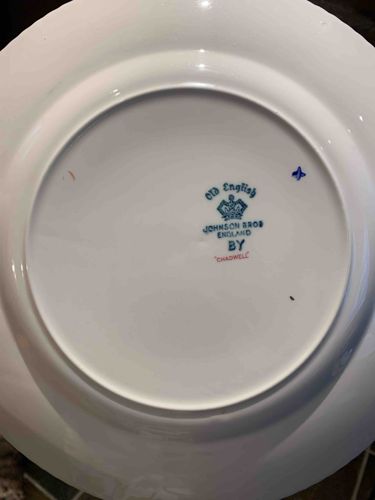
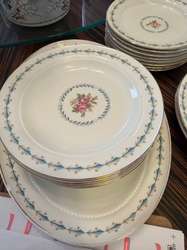
Johnson Bros. 'Old English' 'Chadwell' Pattern Dinner Plate (Reverse)

Dinnerware / Ceramics

AI Estimated Value

·Not an official valuation·Verify before acting

$5-10

As of May 30, 2026

AI Item Analysis

·AI can make mistakes·Verify before acting
The item is the reverse side of a ceramic dinner plate, primarily white with a central circular depression forming a foot rim, and a slightly raised wavy or scalloped edge visible at the very top of the image. The material appears to be a durable ceramic, likely earthenware or ironstone, given the typical production of Johnson Bros. The predominant color is white, with the central maker's mark and pattern name in a dark blue, almost indigo, underglaze transfer print. The mark is centrally located and consists of a crown emblem above the text "old English" in a script font, followed by "JOHNSON BROS" and "ENGLAND" in a more standard block lettering. Below this, "BY" is printed, and then "'CHADWELL'" is inscribed in a reddish-brown or rust-colored script. There is a small, distinct blue cross or asterisk-like mark to the right of the main maker's mark. The surface is glossy, indicating a glazed finish. Visible condition issues include minor surface dust or lint, and a very small, reddish-brown speck, possibly a kiln mark or an inclusion, near the left side of the central depression, and another tiny black speck near the bottom right. The overall condition appears good, with no obvious chips, cracks, or significant wear visible on this side. Johnson Bros. is known for producing sturdy ceramic dinnerware, often dating from the late 19th to mid-20th century. The 'Old English' and 'Chadwell' pattern names suggest a traditional or classic design aesthetic from that era. The underglaze marks indicate good quality manufacturing, as such marks are more durable than overglaze decals.
AI Appraisal Report

·AI can make mistakes·Verify before acting
Upon examining the image of the reverse of this Johnson Bros. dinner plate, I can identify it as part of the 'Old English' series in the 'Chadwell' pattern. The backstamp, featuring a crown over 'Old English' and 'JOHNSON BROS ENGLAND,' is characteristic of their wares from the early to mid-20th century. The underglaze blue transfer print, combined with the hand-painted 'Chadwell' name in reddish-brown, is consistent with authentic production methods of the period. Based on the visual evidence, the plate appears to be in very good condition, with no visible chips, cracks, or crazing on this side. The glaze is intact and glossy. However, this is a very common pattern of mass-produced earthenware. Market conditions for individual Johnson Bros. dinner plates are generally weak unless the pattern is particularly rare or the piece is unusual. The 'Chadwell' pattern is not exceptionally scarce. Current market comparables show single dinner plates of this and similar patterns selling for low values, often in the single digits, through online marketplaces and at antique malls. The primary value lies in completing a set rather than as a standalone decorative item. The low demand and high supply significantly limit its monetary value. It is important to note that this appraisal is based solely on images. While the markings appear authentic, a definitive authentication would require physical inspection to assess the weight, feel of the ceramic and glaze, and to examine the entire piece for damage not visible in the photo, such as hairline cracks or chips on the face or rim.

Get your items appraised

Instant estimates of your treasures with AI-powered appraisals

Browse More Appraisals