AI estimate as of November 4, 2025 · verify with a professional before acting
AI-Generated · Verify before acting
Everything on this page is generated by AI for informational purposes only. AI can make mistakes — the AI may misidentify items or misattribute them (artist, maker, brand, designer, origin, era). This is not an official valuation and should not be used for insurance, sale, tax, estate, legal, or lending purposes — or any decision requiring a certified appraisal. It is not an authoritative claim about any person, brand, or rights holder — do not share or rely on it as a factual statement about a third party. Always consult qualified professionals before making financial decisions.
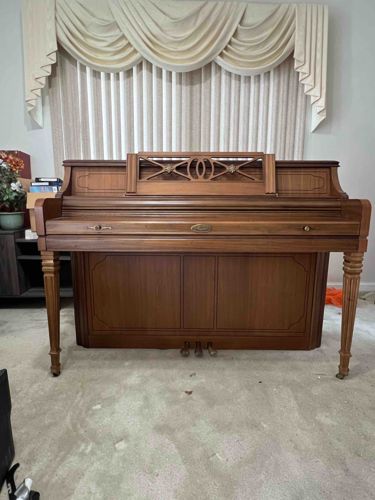
This is an upright piano, likely from the early to mid-20th century, characterized by its warm, medium-brown wood finish, possibly oak or walnut, showing a discernible grain. The overall construction appears solid and sturdy, with a traditional aesthetic. Key physical characteristics include its substantial size, typical of an upright piano, designed to sit fixed against a wall. The piano features ornate turned legs on either side of the keyboard area, which rest on castors, suggesting it can be moved, albeit with effort. The front panel directly below the keyboard showcases a decorative, framed design within the wood, adding a touch of elegance. Above the keyboard, there is a music stand with an intricate, fretwork-style carved design, featuring symmetrical 'X'-shaped elements flanking a central oval motif, indicative of period craftsmanship. The pedals, three in number, are visible at the base, suggesting standard functionality (sustain, sostenuto, and soft pedals). The surface appears to have a polished or varnished finish, which has some visible wear consistent with age and use, including minor scratches or scuffs that form part of its natural patina. There are no obvious signs of significant damage like cracks or major chipping, but detailed inspection would be needed to assess the internal mechanisms and specific state of the keys and hammers. The visible hardware, such as the hinges or latches for the keyboard cover, appear to be brass or a similar golden-toned metal, showing some tarnishing. The overall condition suggests a well-cared-for instrument, though typical signs of aging are present. The style points to a piece that could be late Victorian, Edwardian, or early Art Deco, given the decorative elements and construction technique.
AI Appraisal Report
I have examined this upright piano, which appears to be a solid and traditional instrument dating from the early to mid-20th century. Its warm, medium-brown wood finish, likely oak or walnut, displays a natural grain and typical signs of age-related wear, including minor scuffs and scratches on its polished surface. The ornate turned legs and fretwork-style music stand with 'X'-shaped and oval motifs are consistent with late Victorian, Edwardian, or early Art Deco aesthetics, suggesting period craftsmanship. The presence of three pedals indicates standard functionality. Hardware appears to be brass or a similar golden-toned metal with some tarnishing.
From a visual perspective, the piano is in fair to good condition for its age; there are no immediate signs of significant damage like cracks or major chipping, indicating it has been relatively well-cared for. However, cosmetic condition is only one aspect. The value of upright pianos from this era is highly dependent on their internal mechanical condition, which cannot be assessed from images alone. Factors such as tuning stability, action responsiveness, condition of hammers, strings, and soundboard are critical. Without a physical inspection, including playing the instrument and having a specialist examine its internal components, I cannot comment on its playability or internal integrity.
Market conditions for vintage upright pianos are generally soft; while there's steady demand for playable instruments, many older pianos require significant, costly restoration to reach optimal performance. Rarity is not a major factor here, as many similar pianos were produced. Authenticity in terms of its origin and age seems consistent with the visual cues, but without a serial number, brand information, or provenance documentation, definitive attribution to a specific manufacturer or precise year is impossible. Therefore, the appraisal range accounts for its aesthetic appeal and assumed basic functionality, while acknowledging the inherent risks of unknown internal condition.