AI Appraisal Estimate

AI-generated estimates · not official valuations

From the user

What was submitted

Photo and notes provided by the user — not generated by AI

Submitted item photo
Submitted photo · June 6, 2026

User's notes

No additional notes provided.

AI analysis below

AI appraisal

AI analysis & estimate

AI-Generated · Verify before acting

Everything below is generated by AI for informational purposes only. AI can make mistakes — the AI may misidentify items or misattribute them (artist, maker, brand, designer, origin, era). This is not an official valuation and should not be used for insurance, sale, tax, estate, legal, or lending purposes — or any decision requiring a certified appraisal. It is not an authoritative claim about any person, brand, or rights holder — do not share or rely on it as a factual statement about a third party. Always consult qualified professionals before making financial decisions.

Read the full disclaimer

AI Identification

·Not independently authenticated·Verify before acting

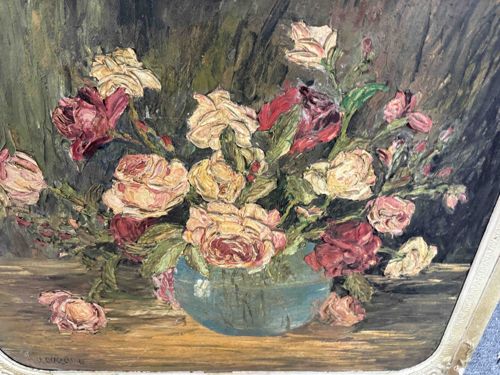
Impressionistic Still Life Oil Painting of Roses in a Bowl

Fine Art

AI Estimated Value

·Not an official valuation·Verify before acting

$800-1,500

As of June 6, 2026

AI Item Analysis

·AI can make mistakes·Verify before acting
This item is an oil painting on what appears to be canvas or board, depicting a still life arrangement of roses in a bowl. The painting features an impressionistic style characterized by thick, visible brushstrokes ('impasto' technique), particularly noticeable in the rendering of the flower petals, which gives them a tactile and dimensional quality. The color palette is dominated by various shades of pink, cream, yellow, and reddish-purple for the roses, contrasted with vibrant green for the foliage and a darker, muted green-brown background. The roses are arranged volumetrically in a light blue or teal-colored shallow bowl or vase, which sits on a wooden surface, rendered with horizontal brushstrokes suggesting planks. Several loose rose petals are visible on the wooden surface, enhancing the naturalistic feel. The background is abstract and dark, allowing the floral arrangement to be the central focus, typical of still life compositions. The overall condition shows signs of age, including potential discoloration or patina on the paint surface, consistent with an older artwork. The edges of the painting suggest it may be housed within a frame, though only a small portion of a light-colored, possibly gilded, decorative frame with carved or molded details is visible on the right and bottom edges. There appears to be a signature or inscription in the bottom left corner, though it is largely illegible from the provided image, possibly reading 'J. DROGE.' The painting's aesthetic suggests a late 19th to early 20th-century period, aligning with the popularity of Impressionism and post-Impressionism. The craftsmanship highlights the artist's ability to convey form and texture through expressive brushwork rather than fine detail.

AI Appraisal Report

·AI can make mistakes·Verify before acting
Based on my visual examination of the provided image, this Impressionistic Still Life Oil Painting of Roses in a Bowl presents as an attractive piece with an estimated value range of $800-1,500. The condition appears consistent with an older work, exhibiting signs of age such as potential discoloration or patina. While the impasto technique is well-executed, contributing significantly to its aesthetic appeal, the illegible signature "J. DROGE" limits immediate authentication. In-person examination would be crucial to confirm the medium, verify the age of the materials, and perform a more thorough condition assessment, including any restoration. Provenance documentation, if available, would significantly impact authenticity and value. From a market perspective, comparable impressionistic floral still lifes from the late 19th or early 20th century by unlisted or regional artists typically fall within this range. Demand for decorative yet artistically rendered floral subjects remains relatively consistent. The painting is not unique enough to be considered rare, but its quality of execution makes it desirable. The indistinct signature is the primary value-limiting factor; a confirmed attribution to a known artist would considerably increase its value, potentially placing it in a higher tier. Without a clearer signature or provenance, it will largely be valued on its decorative merit and artistic quality rather than its historical significance.

Get your items appraised

Instant estimates of your treasures with AI-powered appraisals

Browse More Appraisals