AI estimate as of July 15, 2025 · verify with a professional before acting
AI-Generated · Verify before acting
Everything on this page is generated by AI for informational purposes only. AI can make mistakes — the AI may misidentify items or misattribute them (artist, maker, brand, designer, origin, era). This is not an official valuation and should not be used for insurance, sale, tax, estate, legal, or lending purposes — or any decision requiring a certified appraisal. It is not an authoritative claim about any person, brand, or rights holder — do not share or rely on it as a factual statement about a third party. Always consult qualified professionals before making financial decisions.
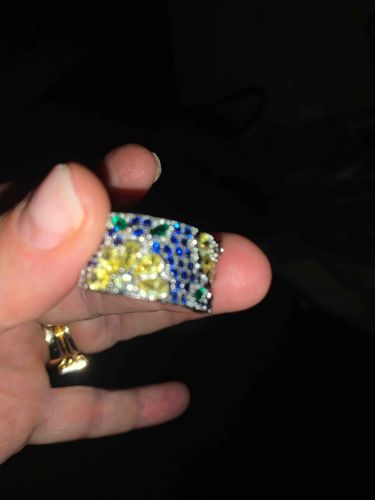
The item appears to be a large, rectangular-shaped ring or a brooch, densely set with numerous faceted gemstones. The primary colors of the stones are vibrant blue and yellow, with smaller green stones interspersed. The blue stones dominate one half of the surface, arranged in a uniform pattern, while the yellow stones cover the other half, forming what appears to be floral or organic motifs, possibly sunflowers or other blooming patterns, although this is not entirely clear from the image. The green stones are strategically placed as accents, particularly at the visible edges where the blue and yellow sections meet, and also as potential 'leaves' for the yellow floral designs. The setting material is a silvery-white metal, possibly rhodium-plated sterling silver, white gold, or platinum, given its bright luster. The overall construction suggests a pave or cluster setting, where stones are set very closely together to cover the metallic surface. The item shows a high degree of sparkle, indicating well-cut stones, although their specific type (e.g., cubic zirconia, topaz, sapphire, citrine) cannot be determined without closer inspection. One side of the item, cradled by a thumb, reveals a slightly curved profile, consistent with a ring that would sit across multiple fingers, or a large statement brooch. There are no visible maker's marks or distinguishing hallmarks in this image. The condition appears good from what is visible, with no obvious missing stones or significant surface wear on the metal. The style is bold and colorful, potentially from the late 20th or early 21st century, designed as a fashion statement piece.
AI Appraisal Report
I have carefully examined the provided image of this multi-gemstone statement piece, which appears to be either a very large ring or a brooch. Visually, the piece is in good condition; I observe no missing stones or significant wear on the metal surface. The dense setting of numerous faceted stones – primarily vibrant blue and yellow, with green accents – creates a striking visual impact. The setting material is a bright, silvery-white metal, which could range from rhodium-plated sterling silver to white gold or platinum. However, without hallmark examination or a direct acid test, I cannot definitively determine the metal composition.
Authenticity of the gemstones themselves is also a key limitation. While they exhibit good sparkle, suggesting decent cuts, their identity (e.g., natural sapphires, citrines, emeralds vs. treated stones vs. synthetic stones vs. simulants like cubic zirconia) cannot be ascertained from an image. This immensely impacts value. Similarly, I cannot confirm if the piece is a genuine antique, vintage designer piece, or a modern mass-produced item.
Given these limitations, my valuation is based on the assumption that this is a well-made, possibly costume or semi-fine jewelry piece featuring synthetic stones or high-quality glass/crystal, and a non-precious or low-karat precious metal setting. Should the stones prove to be natural sapphires, citrines, and emeralds, and the metal precious (e.g., 14k gold), the value would dramatically increase. Market demand for bold, colorful statement pieces is moderate, but rarity depends entirely on the true material composition and maker.
For full authentication and accurate valuation, an in-person examination is crucial. This would involve precise measurement and weighing, spectroscopic analysis of the stones to determine their type and origin, metal testing for purity, and a thorough search for any hidden maker's marks or hallmarks. Provenance documentation, if available, would also be invaluable.