AI estimate as of August 14, 2025 · verify with a professional before acting
AI-Generated · Verify before acting
Everything on this page is generated by AI for informational purposes only. AI can make mistakes — the AI may misidentify items or misattribute them (artist, maker, brand, designer, origin, era). This is not an official valuation and should not be used for insurance, sale, tax, estate, legal, or lending purposes — or any decision requiring a certified appraisal. It is not an authoritative claim about any person, brand, or rights holder — do not share or rely on it as a factual statement about a third party. Always consult qualified professionals before making financial decisions.
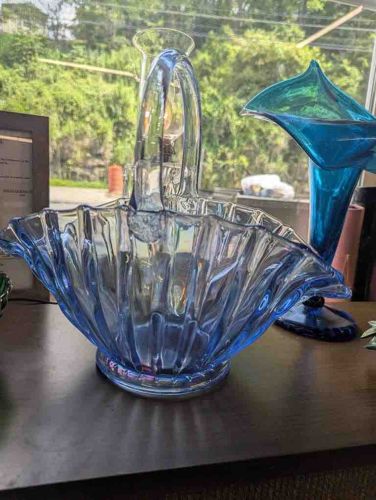
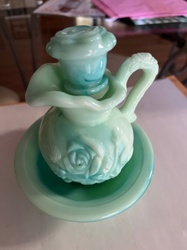
This item is a decorative glass basket, likely made of pressed glass, exhibiting a pale blue or aquamarine tint. Its physical characteristics include a wide, rippled or ruffled rim, giving it a floral or fan-like appearance. The body of the basket is molded with a series of vertical ribs or flutes, which radiate outwards from the foot, enhancing its visual texture and catching the light. A sturdy, clear glass handle is integrated into the design, arching gracefully over the center of the basket. The base is a circular, solid foot, providing stability. The construction appears to be a single piece, with the handle possibly applied or molded during the manufacturing process, a common technique for pressed glass items of this nature. There are no immediately visible condition issues such as chips, cracks, or significant wear, and the glass appears relatively clear and free of cloudiness, suggesting good preservation or quality of material. The color is consistent throughout. Without specific maker's marks visible, it's challenging to determine exact manufacturing details. However, the style, particularly the ruffled edge and pressed glass construction, is highly indicative of pieces from the Mid-20th Century, possibly dating from the 1930s to the 1960s, a period when colored pressed glass was very popular. The craftsmanship, while mass-produced, shows a decent level of detail in the molding.
AI Appraisal Report
Upon my virtual examination of the provided image, this pale blue rippled glass basket presents as a charming piece of decorative glassware. Visually, the condition appears excellent; I detect no obvious chips, cracks, or significant abrasions, and the glass clarity seems very good. This suggests careful handling and storage over its lifespan. Authenticity-wise, based on the style, ruffled rim, fluted body, and integrated handle, it strongly aligns with mass-produced colored pressed glass from the Mid-20th Century, likely 1930s-1960s. This period saw a proliferation of such items from various American and European manufacturers.
In terms of market conditions, decorative pressed glass baskets like this often constitute a niche market, appealing to collectors of specific glass colors or forms, or those seeking vintage home decor. Comparables often include pieces by Fenton, Cambridge, or other prominent pressed glass makers, though without a maker's mark, attribution is impossible. Demand is generally moderate; these are not exceedingly rare items, but well-preserved examples in attractive colors like this pale blue consistently find buyers. Factors positively impacting value include its excellent condition and appealing color. The lack of a visible maker's mark significantly impacts value, as attribution to a desirable manufacturer would command a higher price.
My primary limitation is the lack of physical examination. I cannot verify the absence of hairline cracks, internal fractures, or subtle surface wear that might be invisible in the image. I also cannot assess the quality of the glass or production methods (e.g., presence of mold lines indicating pressed versus blown) with certainty. Full authentication would require in-hand inspection to check for maker's marks, assess tactile condition, and potentially employ UV light for repairs. Provenance documentation, if available, would further authenticate its history and origin.