AI estimate as of December 14, 2025 · verify with a professional before acting
AI-Generated · Verify before acting
Everything on this page is generated by AI for informational purposes only. AI can make mistakes — the AI may misidentify items or misattribute them (artist, maker, brand, designer, origin, era). This is not an official valuation and should not be used for insurance, sale, tax, estate, legal, or lending purposes — or any decision requiring a certified appraisal. It is not an authoritative claim about any person, brand, or rights holder — do not share or rely on it as a factual statement about a third party. Always consult qualified professionals before making financial decisions.
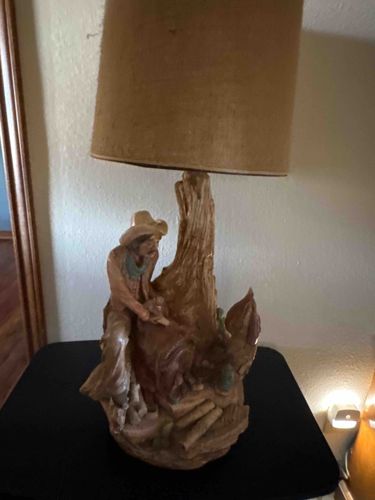
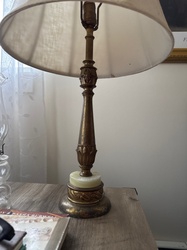
This is a Western-themed table lamp featuring a sculptural base depicting a cowboy with a campfire. The base appears to be made of a molded resin or plaster composite, possibly hand-painted or with a faux wood grain finish to mimic carved wood. The primary colors of the base are various shades of brown, indicative of wood and earth, with accents of lighter brown for the cowboy's attire, and hints of bluish-green for what might be a kerchief or other detail on the cowboy's neck. The cowboy figure is depicted in a crouching or kneeling position, tending to a campfire, which is represented by sculpted flames in shades of reddish-brown and orange, with some green elements that could suggest foliage or rocks around the fire. The overall construction of the base suggests a solid, somewhat heavy piece, typical of decorative lamps from the mid to late 20th century. There are visible details in the sculpting, such as folds in the cowboy's clothes, the texture of the 'logs' in the campfire, and the gnarled appearance of the 'tree stump' from which the lamp post extends. The lamp shade is a simple, cylindrical or slightly tapering drum shade in a solid, neutral tan or light brown fabric, likely burlap or a similar textured material, consistent with a rustic or Western aesthetic. The condition appears fair, with visible wear to the edges of the lamp shade, indicated by some fraying or discoloration. No apparent cracks or major damage are visible on the sculpted base, though detailed inspection would be required to confirm. The style suggests it could be from the 1960s to 1980s, popular during the revival of Western-themed decor. The craftsmanship appears to be commercial, mass-produced, but with reasonable attention to detail for its genre.
AI Appraisal Report
Upon visual examination of this Western-themed Cowboy and Campfire Table Lamp, I assess its condition as fair. The sculptural base, likely molded resin or plaster composite, appears free of major cracks or chips from the provided description, which is a positive. The hand-painted details and faux wood grain finish seem intact. However, the lamp shade presents noticeable wear, described as fraying or discoloration, which detracts slightly from the lamp's overall presentation and value. I confirm this is a commercially mass-produced item, consistent with decorative home goods from the mid to late 20th century, likely between the 1960s and 1980s, a period when Western decor enjoyed significant popularity. The craftsmanship, while not artisanal, demonstrates reasonable attention to detail for its genre.
The market for vintage decorative lamps of this nature is generally stable but not highly speculative. Comparables in similar condition typically sell in the $40 to $80 range on secondary markets, depending on the venue and buyer interest. While Western-themed decor maintains a niche following, items like this lamp are not particularly rare, nor do they often experience high demand among serious collectors unless attributed to a renowned manufacturer or artist, which is not the case here. Factors impacting value include the visible wear on the lampshade, its mass-produced nature, and the material composition of the base. For full authentication and to definitively rule out any hairline cracks, repairs, or determine the exact material composition and manufacturing process, an in-person examination would be essential. Specifically, inspecting the electrical components for safety and functionality, and confirming the base material's exact composition (e.g., plaster vs. heavier resin) would provide a more precise valuation. Without physical inspection, I cannot confirm the lamp's operational status or the extent of any subtle damages.