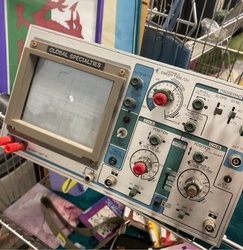
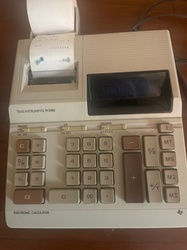
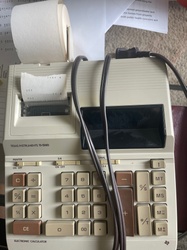
AI estimate as of August 20, 2025 · verify with a professional before acting
AI-Generated · Verify before acting
Everything on this page is generated by AI for informational purposes only. AI can make mistakes — the AI may misidentify items or misattribute them (artist, maker, brand, designer, origin, era). This is not an official valuation and should not be used for insurance, sale, tax, estate, legal, or lending purposes — or any decision requiring a certified appraisal. It is not an authoritative claim about any person, brand, or rights holder — do not share or rely on it as a factual statement about a third party. Always consult qualified professionals before making financial decisions.
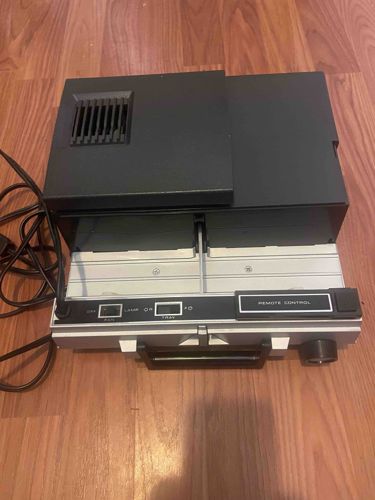
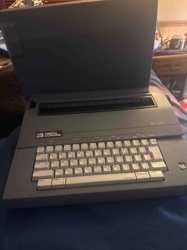
The item appears to be a vintage slide projector, characterized by its rectangular, box-like form factor. The main body consists of a two-tone design, with a dark gray or black plastic upper cover and a lighter, possibly brushed aluminum or painted silver lower section. The overall construction suggests a robust build typical of electronics from the mid-to-late 20th century. A prominent feature on the top is a slatted vent, likely for heat dissipation, indicating the presence of a lamp. The lower section houses the operational controls, which include push-button or rocker switches labeled "ON," "LAMP OFF," and "TRAY." There is also a rectangular slot marked "REMOTE CONTROL," suggesting it had a wired or possibly wireless remote feature, though the remote itself is not visible. A black handle is integrated into the front of the unit, facilitating portability. On the right side, a large, ribbed knob, likely for focus or slide advance, is visible. The power cord, black and coiled, extends from the left side. The physical condition appears generally good for its age, with no significant visible damage or excessive wear, although some scuffs or dust may be present consistent with typical use and storage. The design, with its utilitarian aesthetics and visible mechanical controls, points towards a style period from the 1970s or 1980s. No specific maker's marks or model numbers are discernible from the provided image, precluding identification of the exact manufacturer or model, but the design is indicative of common slide projector brands of that era.
AI Appraisal Report
I have examined the provided image of what appears to be a vintage slide projector. Based on visual cues, the item is in good cosmetic condition for its age, showing typical signs of use but no significant damage. The two-tone design, visible control knobs, and push-button operation are consistent with slide projectors manufactured in the mid-to-late 20th century, likely from the 1970s or 1980s. The integrated handle and remote control slot indicate a fairly robust and feature-rich model for its time. Authenticity, based solely on this image, appears high as a genuine vintage electronic device, but specific manufacturer or model numbers are not discernible, which limits precise identification.
The market for vintage slide projectors is generally niche. While there's a collector's interest in well-preserved or iconic models, many units primarily hold sentimental or decorative value. Functional units are sometimes sought by enthusiasts or for educational purposes, but high demand is uncommon. Rarity is not a significant factor here; similar models were mass-produced. Factors significantly impacting value include operational status (which cannot be determined from an image), included accessories (like the remote or slide trays), and brand reputation. Without knowing if it powers on or functions correctly, and lacking specific model information, its value as an untested, generic unit is limited.
For full authentication and valuation, an in-person examination would be crucial to test functionality, assess internal condition, and check for any hidden damage or modifications. Provenance documentation (original purchase receipts, manuals) would help confirm history, and checking for specific model identifiers or serial numbers would allow for market comparison against exact comparables.