AI Appraisal Estimate

AI-generated estimates · not official valuations

From the user

What was submitted

Photo and notes provided by the user — not generated by AI

Submitted item photo
Submitted photo · May 28, 2026

User's notes

No additional notes provided.

AI analysis below

AI appraisal

AI analysis & estimate

AI-Generated · Verify before acting

Everything below is generated by AI for informational purposes only. AI can make mistakes — the AI may misidentify items or misattribute them (artist, maker, brand, designer, origin, era). This is not an official valuation and should not be used for insurance, sale, tax, estate, legal, or lending purposes — or any decision requiring a certified appraisal. It is not an authoritative claim about any person, brand, or rights holder — do not share or rely on it as a factual statement about a third party. Always consult qualified professionals before making financial decisions.

Read the full disclaimer

AI Identification

·Not independently authenticated·Verify before acting

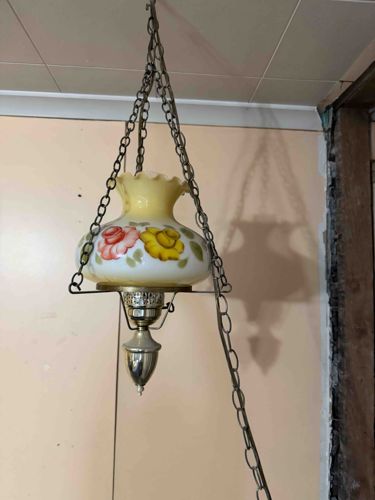
Vintage Hand-Painted Floral Hanging Swag Lamp

Lighting Fixture

AI Estimated Value

·Not an official valuation·Verify before acting

$100-200

As of May 28, 2026

AI Item Analysis

·AI can make mistakes·Verify before acting
This appears to be a vintage hanging swag lamp, likely dating from the mid-20th century, possibly the 1960s to 1970s. It features a two-piece glass shade. The upper portion, which narrows towards the top and has a ruffled or scalloped edge, is made of yellow milk glass. The larger, bulbous lower section of the shade is off-white or opalescent milk glass, decorated with hand-painted floral motifs in hues of red, yellow, and green. The painting style suggests a folk art or casual aesthetic. The lamp is suspended by three ornate, dark-colored metal chains that connect to a central metal canopy hook, designed to be hung from a ceiling. A fourth, longer chain extends from the canopy, presumably to a wall outlet for power, indicating its 'swag' style. The hardware supporting the glass shade is made of brass or a brass-toned metal, featuring a decorative finial at the bottom. The metal components show signs of age, including some tarnishing or a darkened patina consistent with older brass or plated metals. There are no visible maker's marks or signatures in the provided images. The overall condition appears consistent with its age, with no obvious cracks or chips in the glass, though a close inspection for wear on the painted details and electrical components would be necessary for a full appraisal. The craftsmanship points to mass production typical of decorative lighting during its style period, with the hand-painting adding a unique, artisanal touch to each piece.
AI Appraisal Report

·AI can make mistakes·Verify before acting
Having carefully examined the provided image of this vintage hand-painted floral swag lamp, my assessment is as follows. The lamp appears authentic to the mid-20th century, likely 1960s to 1970s, based on its design, milk glass components, and 'swag' style. Visually, the condition seems good for its age, with no apparent cracks or chips in the two-piece glass shade. The brass-toned hardware shows an expected patina consistent with age. The hand-painted floral motifs contribute to its kitschy charm, typical of the era's decorative lighting. The market for vintage swag lamps, especially those mass-produced with hand-painted details, is moderately active. Comparables on online marketplaces suggest values in the $75-$250 range, depending heavily on condition, specific artistic flair, and perceived rarity. While 'hand-painted' implies uniqueness, the style indicates mass production where individual artists applied the decals or paint, rather than a singular fine art piece. Demand is driven primarily by collectors of vintage lighting and interior decorators seeking period-specific accents. It is not particularly rare, but good condition examples are always more desirable. The 'swag' wiring and hanging mechanism are key to its identity. Factors impacting value include the integrity of the paintwork, absence of chips/cracks, and the functionality and safety of the electrical components. Without an in-person examination, I cannot definitively assess the internal wiring's condition, which is crucial for safety and usability. Furthermore, I can’t verify the actual material of the 'brass-toned' hardware. A physical inspection would also confirm the extent of paint wear and ensure all original components are present and functional. Provenance would be beneficial but is rarely available for such items.

Get your items appraised

Instant estimates of your treasures with AI-powered appraisals

Browse More Appraisals