AI estimate as of September 11, 2025 · verify with a professional before acting
AI-Generated · Verify before acting
Everything on this page is generated by AI for informational purposes only. AI can make mistakes — the AI may misidentify items or misattribute them (artist, maker, brand, designer, origin, era). This is not an official valuation and should not be used for insurance, sale, tax, estate, legal, or lending purposes — or any decision requiring a certified appraisal. It is not an authoritative claim about any person, brand, or rights holder — do not share or rely on it as a factual statement about a third party. Always consult qualified professionals before making financial decisions.
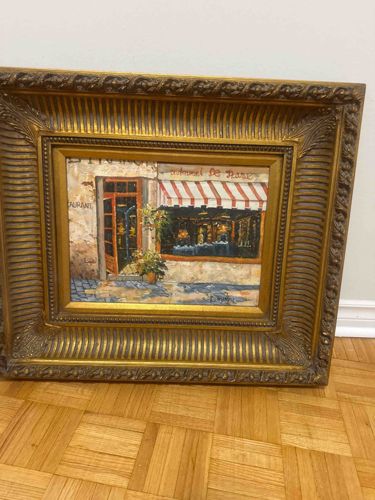
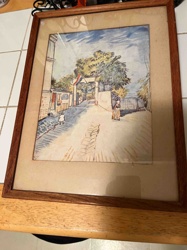
This item is a framed painting depicting the exterior facade of what appears to be a French restaurant or cafe. The painting itself is rendered in a realistic, perhaps impressionistic, style, focusing on architectural details and street-level activity. The primary colors include various shades of brown, beige, and white for the stone or stucco wall, vibrant red and white stripes for the awning, and blue and dark tones for the interior visible through the window. A cobblestone street or patio in blues and greys is visible in the foreground. Notable features include a partially open wooden door with glass panels on the left, a large display window with visible interior lighting and possible patrons or decor on the right, and a striped awning above the window bearing what looks like handwritten text, possibly "Restaurant De Parte" or similar, though it is somewhat illegible. A potted plant with green foliage and yellow flowers sits on the ground near the door. The artistic quality appears to be good, with decent attention to detail and perspective. The painting is housed within a substantial, ornate gold-colored frame. The frame features a classic design with multiple concentric decorative elements: an innermost smooth gold band, followed by a ribbed or fluted section, and an outermost band with repeating acanthus leaf or floral motifs. The frame corners are mitered and show no obvious signs of separation. The overall condition of both the painting and the frame appears to be very good, with no visible damage, significant wear, or repairs. There may be a slight patina on the gold frame consistent with age, but it contributes to the aesthetic rather than detracting from it. The painting does not clearly show a discernible artist's signature or manufacturing mark, but based on the style and subject matter, it likely dates from the late 20th century to early 21st century.
AI Appraisal Report
Based on my visual examination of the provided image of the Framed Painting of a French Restaurant Facade, I assess its condition to be very good. Both the painting and its substantial, ornate gold-colored frame appear free from damage, significant wear, or repairs. The slight patina on the frame is consistent with age and enhances its aesthetic. Authenticity, based solely on this image, suggests the piece is a decorative work, likely late 20th to early 21st century, given its style and subject matter. There's no visible artist's signature, limiting specific attribution.
In terms of market conditions, this type of charming, representational art depicting European street scenes has a consistent, albeit modest, demand among general art collectors and for decorative purposes. Its lack of a known artist or established provenance means it falls into the category of 'decorative art' rather than 'fine art' for valuation purposes. Comparable sales for similar unsigned, good-quality framed works of this size and subject typically range in the hundreds. The ornate frame adds to its decorative appeal and perceived value.
Demand is steady for attractive, well-executed pieces that complement home decor. Rarity is not a factor here; many artists produce similar scenes. The main factors impacting value are the very good condition, attractive subject matter, and the quality of the frame. The absence of an artist's signature significantly limits its upside potential as a collectible.
Limitations regarding authenticity verification from images alone are significant. A full in-person examination would allow me to inspect brushwork, canvas, and frame construction more closely, and confirm materials. Provenance documentation (e.g., bills of sale, exhibition history) would be crucial for establishing authorship and a more precise date. Scientific testing, such as pigment analysis, could confirm age and materials if there were questions of forgery, though that seems unlikely for a piece of this nature.