AI estimate as of September 6, 2025 · verify with a professional before acting
AI-Generated · Verify before acting
Everything on this page is generated by AI for informational purposes only. AI can make mistakes — the AI may misidentify items or misattribute them (artist, maker, brand, designer, origin, era). This is not an official valuation and should not be used for insurance, sale, tax, estate, legal, or lending purposes — or any decision requiring a certified appraisal. It is not an authoritative claim about any person, brand, or rights holder — do not share or rely on it as a factual statement about a third party. Always consult qualified professionals before making financial decisions.
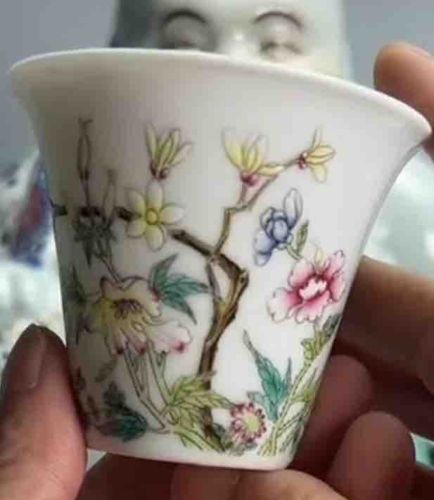
This item is a small, delicate porcelain tea cup, likely intended for gongfu tea service given its diminutive size and flaring rim. It features a finely painted enamel decoration depicting a flourishing tree branch with various colorful blossoms and foliage. The primary colors in the floral motif include soft yellows, delicate pinks, blues, and various shades of green for the leaves, all set against a pristine white porcelain ground. The branch itself is rendered in tones of brown with some subtle textural detailing. The cup appears to be thin-walled, suggesting high-quality porcelain or celadon. The craftsmanship indicates hand-painted details, with visible brushstrokes and nuanced color variations within the individual petals and leaves, showcasing a high level of artistic skill. The rim of the cup flares slightly outward, providing an elegant silhouette. No obvious chips, cracks, or repairs are visible from the presented angle, and the enamel appears to be largely intact with good retention of color saturation, indicating careful handling or excellent preservation. The surface exhibits a subtle sheen typical of glazed porcelain. While no specific maker's marks or signatures are discernible from the image, the style of decoration is characteristic of traditional Chinese porcelain, possibly dating from the Qing Dynasty or later, given the intricate enameling. The precise age would require examining the base for reign marks or other identifiers. The overall impression is one of refinement and aesthetic appeal.
AI Appraisal Report
I have carefully examined the provided image of this Chinese porcelain tea cup with floral enamel decoration. Based on my visual assessment, the cup appears to be in excellent condition. There are no readily visible chips, cracks, or repairs, and the enamel decoration shows remarkable color saturation and integrity, suggesting careful preservation. The finely detailed, hand-painted floral motif, with its vibrant palette of yellows, pinks, blues, and greens against a pristine white ground, speaks to a high level of artistic skill and craftsmanship.
From the image, the thin-walled nature of the porcelain and the elegant flaring rim indicate quality craftsmanship, possibly consistent with later Qing Dynasty or Republic period productions. The style of enameling is indeed characteristic of traditional Chinese porcelain.
In terms of market conditions, smaller, exquisitely decorated Chinese porcelain tea wares, especially those in excellent condition, are consistently sought after by collectors. Comparables would include similar enameled tea cups from the 19th or early 20th century. Demand for such items remains steady, driven by collectors of fine Chinese ceramics.
Factors significantly impacting value include the exceptional condition, the delicate hand-painted artistry, and the implied age. The absence of visible damage and the vibrancy of the enamels are key value drivers.
However, it is crucial to note the limitations of an appraisal based solely on images. Authenticity verification from images alone is inherently limited. I cannot definitively confirm its precise age, period, or provenance. A full authentication would require physical examination to inspect the base for reign marks, potter's seals, or other identifiers. Furthermore, an in-person examination would allow for a tactile assessment of the porcelain's feel, weight, and transparency, and potentially scientific testing (e.g., thermoluminescence dating) could provide a more definitive age. Provenance documentation, if available, would also significantly enhance its value and confirm its history.