Indigenous Feather Fan or Prayer Fan
Cultural Artifacts / Indigenous Art & Regalia

Indigenous Feather Fan or Prayer Fan

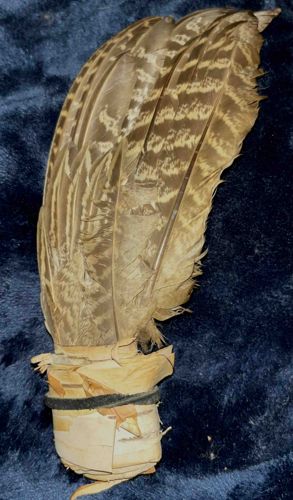
This item is a handcrafted ceremonial or decorative fan, likely of Indigenous North American origin. It consists of multiple wing feathers, possibly from a large bird such as a turkey or hawk, characterized by distinct brown and tan horizontal barring. The feathers are arranged in a flat, overlapping fanned structure and are bound at the base. The handle is constructed from wrapped birch bark, secured with a dark, possibly leather or sinew, band. The birch bark handle shows natural peeling and a weathered, light tan color, suggesting some age. The feathers exhibit moderate wear, with some fraying and separation of the barbs at the edges, particularly towards the tips. No specific maker's marks or signatures are visible in the image. The construction quality indicates traditional hand-craftsmanship, typically used in smudge ceremonies, powwows, or as prayer fans. The overall condition appears to be fair to good, with natural patina on the organic materials and no visible modern adhesive repairs. Based on the material degradation and style, it likely dates to the mid-to-late 20th century.
Estimated Value

$450 - $650

Basic Information

Category

Cultural Artifacts / Indigenous Art & Regalia

Appraised On

March 7, 2026

Estimated Value

$450 - $650

Item Description

This item is a handcrafted ceremonial or decorative fan, likely of Indigenous North American origin. It consists of multiple wing feathers, possibly from a large bird such as a turkey or hawk, characterized by distinct brown and tan horizontal barring. The feathers are arranged in a flat, overlapping fanned structure and are bound at the base. The handle is constructed from wrapped birch bark, secured with a dark, possibly leather or sinew, band. The birch bark handle shows natural peeling and a weathered, light tan color, suggesting some age. The feathers exhibit moderate wear, with some fraying and separation of the barbs at the edges, particularly towards the tips. No specific maker's marks or signatures are visible in the image. The construction quality indicates traditional hand-craftsmanship, typically used in smudge ceremonies, powwows, or as prayer fans. The overall condition appears to be fair to good, with natural patina on the organic materials and no visible modern adhesive repairs. Based on the material degradation and style, it likely dates to the mid-to-late 20th century.
Get Your Items Appraised

Instant estimates of your treasures with AI-powered instant appraisals

Browse More Appraisals