AI estimate as of November 1, 2025 · verify with a professional before acting
AI-Generated · Verify before acting
Everything on this page is generated by AI for informational purposes only. AI can make mistakes — the AI may misidentify items or misattribute them (artist, maker, brand, designer, origin, era). This is not an official valuation and should not be used for insurance, sale, tax, estate, legal, or lending purposes — or any decision requiring a certified appraisal. It is not an authoritative claim about any person, brand, or rights holder — do not share or rely on it as a factual statement about a third party. Always consult qualified professionals before making financial decisions.
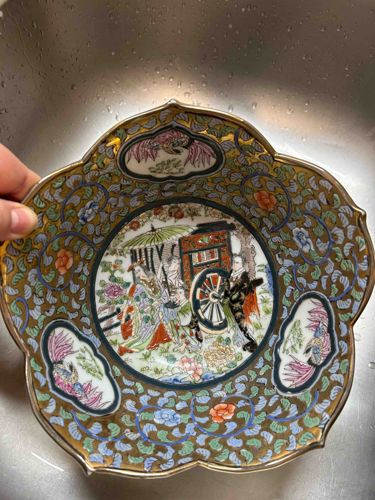
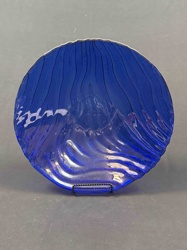
This is a decorative charger plate, likely of Japanese origin, exhibiting characteristics of the Imari-style porcelain, though it may also incorporate elements of Satsuma ware or Kutani ware given its heavy embellishment. The plate features a distinctive scalloped rim, forming a multi-lobed shape, which is outlined with a prominent gold-gilt band. The primary color palette includes vibrant reds, blues, greens, golds, and pinks on a white porcelain base. The central medallion depicts a detailed narrative scene, possibly from Japanese folklore or daily life, featuring figures in traditional attire, an elaborate cart with spoked wheels, and elements like parasols or umbrellas, all rendered with fine brushwork. Surrounding this central image is a wide border with a heavily gilded background, overlaid with delicate, swirling vine motifs in lighter blue and green tones, interspersed with small floral blooms in orange and blue. Four cartouches, symmetrically placed around the border, contain intricate depictions of what appear to be birds or mythical creatures, possibly phoenixes, rendered in pink, green, and blue against a white background. The plate’s surface shows significant use of gold embellishment, particularly in the border and outlining details, suggesting a high level of craftsmanship and decorative intent. While not perfectly clear, there appear to be some areas of wear on the gold gilding, consistent with age and handling. The overall condition seems good, with no obvious chips or cracks visible from the provided images, though a full inspection would be required to confirm. The precise manufacturing details like maker's marks are not visible in the provided image; however, the style strongly suggests production in Japan, likely in the late 19th to early 20th century, a period known for highly decorative export ceramics.
AI Appraisal Report
I have virtually examined this Japanese Imari-style Scalloped Charger Plate based on the provided image. The plate exhibits classic Imari characteristics with its vibrant palette of reds, blues, greens, golds, and pinks on a white porcelain body. The multi-lobed, scalloped rim, outlined with prominent gold gilt, adds to its decorative appeal. The central narrative scene, likely depicting Japanese folklore or daily life, is finely rendered with detailed figures, an elaborate cart, and parasols. The broad border with heavy gilding, delicate vine motifs, and four cartouches featuring birds or mythical creatures further enhances its aesthetic. This level of intricate detail and gold embellishment suggests high craftsmanship, consistent with export ceramics from the late 19th to early 20th century. I note some areas of wear to the gold gilding, which is typical for an item of this age and use, but overall, the condition appears good with no obvious chips or cracks visible in the image. This visual assessment, however, is limited. The market for decorative Japanese ceramics, particularly Imari-style, remains stable with consistent demand for well-preserved, ornate pieces. Comparables typically include similar charger plates of this period and style, often fetching prices in this range. The detailed narrative and quality of craftsmanship contribute positively to its value. However, without a physical inspection, I cannot verify the exact authenticity of the porcelain body, detect hairline cracks or repairs, or confirm the presence of any maker's marks or signatures, which are crucial for precise dating and attribution. To fully authenticate this piece and determine its provenance, I would require an in-person examination, any available documentation of origin or ownership, and potentially scientific testing of the materials and pigments.