AI estimate as of September 25, 2025 · verify with a professional before acting
AI-Generated · Verify before acting
Everything on this page is generated by AI for informational purposes only. AI can make mistakes — the AI may misidentify items or misattribute them (artist, maker, brand, designer, origin, era). This is not an official valuation and should not be used for insurance, sale, tax, estate, legal, or lending purposes — or any decision requiring a certified appraisal. It is not an authoritative claim about any person, brand, or rights holder — do not share or rely on it as a factual statement about a third party. Always consult qualified professionals before making financial decisions.
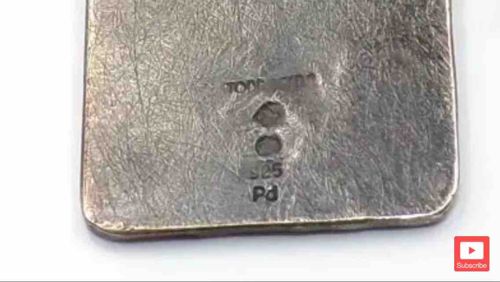
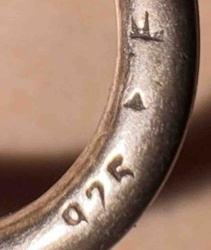
The item is a roughly rectangular, flat metallic component, likely a tag or part of a larger piece of jewelry. Its primary material appears to be sterling silver, indicated by the 'S925' hallmark, which is standard for '.925' purity silver. Additionally, it bears the marking 'Pd', signifying the presence of Palladium. This suggests an alloy or a bi-metal construction where Palladium is incorporated, possibly to enhance hardness, reduce tarnish, or for aesthetic purposes. The surface exhibits a brushed or textured finish, contributing to a muted, semi-matte appearance rather than a high polish. There are visible surface scratches and minor abrasions consistent with wear and handling, indicating a used condition. A dark tarnished patina is present in recessed areas and along the edges, which is typical for sterling silver that has not been recently polished. The component features clear manufacturing marks: 'TODDPOWNELL' (partially obscured, but readable as Todd Pownell), 'S925', and 'Pd'. These marks confirm the maker, the silver fineness, and the inclusion of Palladium, respectively. The craftsmanship appears robust, with clear, impressed hallmarks. The edges are slightly rounded, suggesting a finished product design. Given the combination of sterling silver and palladium, and the designer name, this piece likely belongs to a contemporary artisan jewelry collection, possibly dating from the late 20th century to the present day. The presence of Palladium is a quality indicator, as it is a precious and durable metal.
AI Appraisal Report
I have examined the provided image of the Todd Pownell Palladium and Sterling Silver Component. Based on this visual inspection, the item appears to be an authentic Todd Pownell piece, evidenced by the distinct and legible 'TODDPOWNELL' hallmark, although partially obscured, along with the 'S925' and 'Pd' marks. The condition is consistent with a used jewelry component, exhibiting surface scratches, abrasions, and noticeable tarnish, particularly in recessed areas. This tarnish is typical for sterling silver and does not inherently detract from authenticity, but impacts aesthetic appeal. The brushed finish is a signature style often seen in contemporary artisan jewelry.
Market conditions for individual components, even from reputable designers like Todd Pownell, are generally lower than for finished jewelry pieces. Comparables would include other designer-branded silver or silver-and-palladium components. Demand for such raw components is niche, primarily appealing to jewelers for repairs/modifications or collectors seeking specific branded parts. The inclusion of Palladium ('Pd') adds a layer of quality and value over pure sterling silver, given Palladium's status as a precious metal. However, without knowing the total weight or the specific percentage of Palladium, its contribution to intrinsic metal value is speculative from an image alone.
Factors significantly impacting value include the designer's reputation, the precious metal content (Palladium, Sterling Silver), and the overall condition. The visible wear and tarnish suggest a lower end of the value spectrum compared to a pristine component.
It is crucial to note the limitations of authenticity verification from images alone. While hallmarks appear genuine, a full authentication would require in-person examination to assess the quality of craftsmanship, confirm the weight, and verify the metal composition through scientific testing (e.g., XRF analysis for Pd content, if significant enough). Furthermore, any provenance documentation, such as original purchase receipts, would greatly enhance certainty and potentially value.