These notes were written by the person who submitted this item. Appraiser.AI has not verified them, and the AI's identification and estimate may rely on them.
AI Estimated Value
Not an official valuation
$400-600
AI estimate as of September 8, 2025 · verify with a professional before acting
AI-Generated · Verify before acting
Everything on this page is generated by AI for informational purposes only. AI can make mistakes — the AI may misidentify items or misattribute them (artist, maker, brand, designer, origin, era). This is not an official valuation and should not be used for insurance, sale, tax, estate, legal, or lending purposes — or any decision requiring a certified appraisal. It is not an authoritative claim about any person, brand, or rights holder — do not share or rely on it as a factual statement about a third party. Always consult qualified professionals before making financial decisions.
This analysis also relies on unverified notes provided by the user, which may be incomplete or inaccurate and could affect the result.
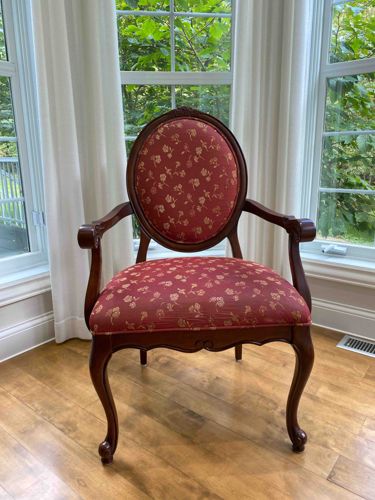
This is a single armchair, likely crafted from a dark, possibly stained or lacquered wood, exhibiting a rich reddish-brown hue. The chair features a distinct Louis XVI style, characterized by its elegant curves and ornate details. The backrest is an upholstered oval panel, framed by a carved wooden border, which appears to have a subtle beaded or reeded detail along its inner edge. The upholstery on both the backrest and the seat cushion is a deep red or burgundy fabric, adorned with a repeating pattern of small, delicate floral motifs in a lighter, possibly gold or beige, color, adding a touch of classic sophistication. The armchair has elegantly curved arms that gracefully terminate in volute or scroll-like details where they meet the front supports. These supports and the front legs are cabriole-style, ending in a slightly scrolled or club foot, indicative of French Rococo or transition pieces, though the overall design leans more towards the refined elegance of Louis XVI. Visible condition appears good, with no obvious signs of significant wear or damage to the fabric, which shows a slight sheen. The wooden frame appears sturdy, with a well-maintained finish, though closer inspection might reveal minor surface scratches or patina consistent with age and use. The craftsmanship is evident in the finely turned and carved elements, suggesting a piece of good quality, possibly from the late 19th or early to mid-20th century as a revival piece.
AI Appraisal Report
Based on my visual examination of the provided image, this French Louis XVI Style Oval Back Armchair appears to be in good overall condition. The wooden frame, likely stained or lacquered, exhibits a rich reddish-brown hue and a well-maintained finish, showing no obvious signs of significant damage that compromise its structural integrity. The upholstery, a deep red or burgundy fabric with delicate floral motifs, also appears to be in good condition, with a slight sheen and no visible tears or significant wear. The craftsmanship, evident in the carved and turned elements, suggests a quality revival piece rather than an original 18th-century antique. The cabriole legs ending in a scrolled foot, while elegant, lean slightly towards Rococo influences, suggesting a late 19th or early to mid-20th-century interpretation of the Louis XVI style.
In terms of market conditions, Louis XVI revival pieces remain popular, though their value is influenced by age, quality of materials, and condition. Comparables in the current market for well-maintained revival armchairs of this style typically range from $300-$700. The specific detailed carvings and good condition of both wood and fabric contribute positively to its value. Demand for well-executed period revival furniture is steady but not rare, meaning this piece is generally accessible. Factors impacting value include its age (as a revival piece), the quality of its construction, and its excellent visual condition.
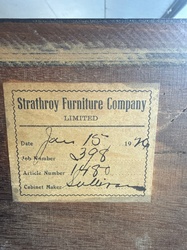
It is crucial to note that this assessment is based solely on high-resolution images. Full authentication of age and specific wood type would require an in-person examination to inspect joinery, patination, and any hidden marks. Provenance documentation, if available, would further verify its history and origin. Scientific testing, such as dendrochronology, would be necessary for definitive dating of the wood. Without physical inspection, I cannot entirely rule out professional restoration or repairs that are not visible in photographs, nor can I confirm the exact species of wood used.