AI Appraisal Estimate

AI-generated estimates · not official valuations

From the user

What was submitted

Photo and notes provided by the user — not generated by AI

Submitted item photo
Submitted photo · May 26, 2026

User's notes

No additional notes provided.

AI analysis below

AI appraisal

AI analysis & estimate

AI-Generated · Verify before acting

Everything below is generated by AI for informational purposes only. AI can make mistakes — the AI may misidentify items or misattribute them (artist, maker, brand, designer, origin, era). This is not an official valuation and should not be used for insurance, sale, tax, estate, legal, or lending purposes — or any decision requiring a certified appraisal. It is not an authoritative claim about any person, brand, or rights holder — do not share or rely on it as a factual statement about a third party. Always consult qualified professionals before making financial decisions.

Read the full disclaimer

AI Identification

·Not independently authenticated·Verify before acting

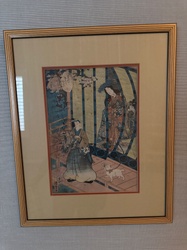
Framed Torii Kiyonaga Ukiyo-e Woodblock Print

Asian Art and Antiques - Japanese Prints

AI Estimated Value

·Not an official valuation·Verify before acting

$150-350

As of May 26, 2026

AI Item Analysis

·AI can make mistakes·Verify before acting
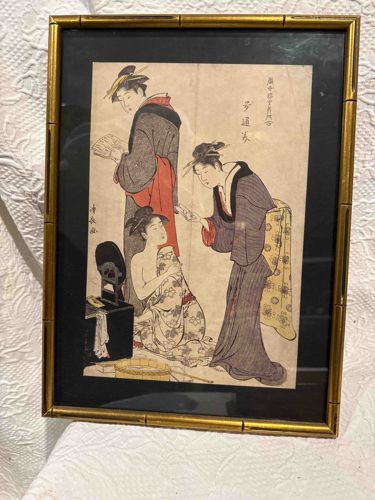
This item is a framed Japanese ukiyo-e woodblock print, attributed in style and signature to Torii Kiyonaga (1752–1815), a master of the Edo period. The artwork depicts a 'bijin-ga' (beautiful women) scene featuring three women in a domestic interior setting. One woman is seated before a mirror box (kyodai) while tending to her toilette, while two standing figures interact behind her wearing traditional layered kimonos with intricate patterns and obi sashes. The color palette includes muted earthy tones, deep blacks, and faded reds, characteristic of aged organic pigments. The print is housed in a gold-finished faux-bamboo (chinoiserie style) metal frame with a black mat. In terms of condition, the paper shows significant signs of age, including vertical creasing (likely from previous folding), consistent foxing, and overall yellowing/browning of the paper substrate. There is visible waviness in the paper, suggesting it is not perfectly flat against the backing. The signature and inscriptions are visible in the upper right and left-middle sections. Without physical inspection of the paper grain and reverse-side ink bleed, it is difficult to determine if this is an original late 18th-century strike or a high-quality late 19th-century Meiji-era reproduction.

AI Appraisal Report

·AI can make mistakes·Verify before acting
This framed woodblock print, attributed to the master Torii Kiyonaga but likely a later re-strike, presents a classic bijin-ga scene. In my visual examination, I note the composition is consistent with Kiyonaga's famed tall, elegant figures. However, several factors suggest this is a later reproduction rather than an 18th-century original. The condition is fair to poor; there is significant toning and foxing across the substrate, and the vertical crease lines suggest the paper was previously folded or rolled improperly. The visible waviness indicates it has not been laid down or hinged correctly within its current mount. The coloring appears somewhat flat, lacking the subtle mica dust or delicate bokashi (gradated ink) often found in period originals. While the faux-bamboo frame adds decorative value, it does not enhance the archival stability of the piece. Authentic 18th-century prints by Kiyonaga are exceedingly rare and command prices in the thousands ($3,000+). However, without viewing the reverse of the paper to check for ink bleed-through or keyblock impression depth, I must value this based on the likelihood of it being a late Meiji (late 19th c.) or Showa era reproduction. Authenticating Edo-period prints requires tactile inspection of the paper grain (washi) and confirmation of publisher seals, which are indistinct here. Consequently, the value is derived primarily from its decorative appeal as an older reproduction rather than as investment-grade antiquity. If proven to be an early strike through scientific analysis or provenance, the value would increase significantly.

Get your items appraised

Instant estimates of your treasures with AI-powered appraisals

Browse More Appraisals