These notes were written by the person who submitted this item. Appraiser.AI has not verified them, and the AI's identification and estimate may rely on them.
AI Estimated Value
Not an official valuation
$150-250
AI estimate as of July 16, 2025 · verify with a professional before acting
AI-Generated · Verify before acting
Everything on this page is generated by AI for informational purposes only. AI can make mistakes — the AI may misidentify items or misattribute them (artist, maker, brand, designer, origin, era). This is not an official valuation and should not be used for insurance, sale, tax, estate, legal, or lending purposes — or any decision requiring a certified appraisal. It is not an authoritative claim about any person, brand, or rights holder — do not share or rely on it as a factual statement about a third party. Always consult qualified professionals before making financial decisions.
This analysis also relies on unverified notes provided by the user, which may be incomplete or inaccurate and could affect the result.
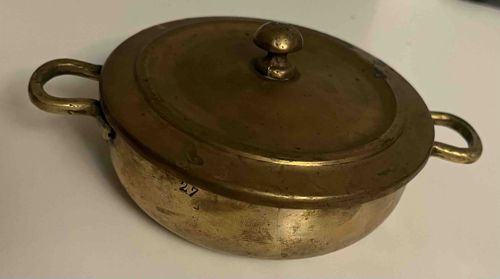
This is a small, round, lidded pot, likely crafted from brass or a similar copper alloy, exhibiting a rich, dark brown historical patina, suggesting significant age and use. The pot features a hemispherical body with a slightly flattened base, measuring approximately 4-6 inches in diameter based on its appearance as a personal serving or cooking vessel. Two opposing handles, each a simple, curved loop, are riveted or soldered directly to the pot's side, indicating a robust, functional construction. The lid is flat with a subtle, raised lip designed to fit snugly onto the pot, and is topped with a single, mushroom-shaped finial that serves as a handle. The surface of the pot shows visible signs of wear, including minor scratches and abrasions consistent with regular handling and cleaning over many years. There are no obvious dents or major structural damages, suggesting good overall preservation. A faint inscription, possibly '27', is etched or stamped into the side of the pot, which could be an inventory number, a weight, or a capacity marking, but its exact meaning is unknown without further context. The overall craftsmanship appears utilitarian but well-executed, with smooth, consistent curves and sturdy attachments. The metal displays varied tones, with some areas appearing lighter due to handling or cleaning, contrasted by the deeper, oxidized patina in less disturbed areas. The form factor suggests it could have been used for cooking, serving, or storing small portions of food, perhaps dishes like dal or curries. Given the context of a likely South Asian origin and a purchase date in the 1960s, this item could date from the first half of the 20th century or even earlier, embodying traditional metalworking techniques from the region.
AI Appraisal Report
Upon examining the provided image and information regarding this small lidded brass pot, I assess its condition as good, especially considering its apparent age and utilitarian function. The dark brown patina is consistent with a genuine historical piece, and the minor scratches and abrasions indicate authentic use rather than contrived wear. The construction details, such as the riveted handles and mushroom-shaped finial, appear consistent with traditional South Asian metalworking, supporting the item's likely origin and purchase date in the 1960s. The faint '27' inscription is intriguing; without further context, its meaning remains speculative, but it adds to the individual character.
In terms of market conditions, comparable antique brass kitchenware or serving vessels from South Asia generally exhibit moderate demand among collectors of ethnographic art, antique kitchenalia, and devotees of cultural artifacts. While not exceptionally rare, pieces in good, unrestored condition with an appealing patina and clear signs of age are more desirable.
Factors significantly impacting value include its age, perceived authenticity, condition, and the aesthetic appeal of its patina. The utilitarian nature, while desirable for some collectors, prevents it from reaching the higher values associated with more ornate or historically significant ceremonial objects.
It is crucial to note the limitations of authenticating solely from images. A physical examination would allow me to assess the metal's exact composition, detect subtle repairs, and more accurately gauge the depth and uniformity of the patina. Provenance documentation, such as original purchase receipts or family records, would robustly confirm its South Asian origin and 1960s acquisition. Scientific testing, like X-ray fluorescence (XRF) to analyze the alloy composition, could further corroborate its age range. Without these, my assessment of authenticity is based on visual consistency and the owner's provided context, which appears credible.