AI Appraisal Estimate

AI-generated estimates · not official valuations

From the user

What was submitted

Photo and notes provided by the user — not generated by AI

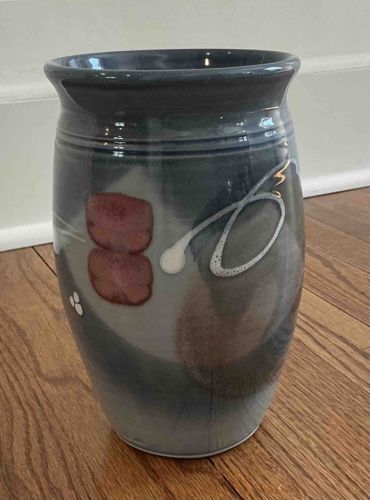
Submitted item photo
Submitted photo · May 19, 2026

User's notes

Signed James Brooke pottery vase. Received as a gift in the 1980’s. 8” tall

AI analysis below

AI appraisal

AI analysis & estimate

AI-Generated · Verify before acting

Everything below is generated by AI for informational purposes only. AI can make mistakes — the AI may misidentify items or misattribute them (artist, maker, brand, designer, origin, era). This is not an official valuation and should not be used for insurance, sale, tax, estate, legal, or lending purposes — or any decision requiring a certified appraisal. It is not an authoritative claim about any person, brand, or rights holder — do not share or rely on it as a factual statement about a third party. Always consult qualified professionals before making financial decisions.

Note

This analysis also relies on unverified notes provided by the user, which may be incomplete or inaccurate and could affect the result.

Read the full disclaimer

AI Identification

·Not independently authenticated·Verify before acting

Signed James Brooke Studio Pottery Vase

Studio Pottery / Art Ceramics

AI Estimated Value

·Not an official valuation·Verify before acting

$150 - $250

As of May 19, 2026

AI Item Analysis

·AI can make mistakes·Verify before acting
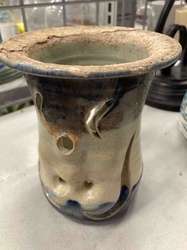
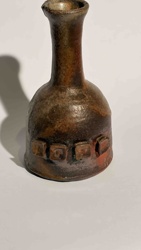
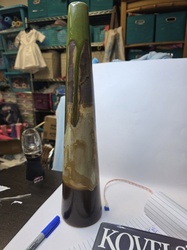
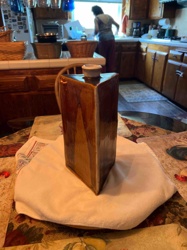
This 8-inch tall studio pottery vase is a distinguished example of modern ceramics, attributed to artist James Brooke and dating to the 1980s. The vessel features an ovoid or tapered cylindrical form with a flared rim and visible horizontal throwing rings near the top, indicating it was hand-turned on a pottery wheel. The glaze work is highly artistic, utilizing a layered approach with a base of matted grey, blue, and teal tones. It is decorated with abstract, expressionist motifs including two stacked, russet-colored rectangular shapes and a white, calligraphic slip-trailed flourish that adds dynamic movement to the composition. The surface displays a complex interplay of matte and high-gloss finishes, characteristic of high-fire studio pottery. The construction shows high craftsmanship with a balanced weight and a clean, trimmed foot. Based on the provided context, the piece is signed (likely on the underside) and remains in excellent vintage condition with no visible cracks, chips, or major crazing. The style is emblematic of the American studio craft movement of the late 20th century, focusing on unique surface decoration and functional but sculptural forms.
AI Appraisal Report

·AI can make mistakes·Verify before acting
I have conducted a visual examination of the 8-inch signed James Brooke studio pottery vase. Based on the ovoid form and the sophisticated application of layered matte and gloss glazes, the piece represents a high-quality example of American mid-to-late 20th-century studio craft. The condition appears excellent with no visible structural defects, and the distinct calligraphic slip-trailing suggests a mature artistic hand. Market demand for 1980s studio pottery remains stable, though localized to collectors of specific regional movements or stylistic eras. Currently, mid-sized vessels by Brooke and his contemporaries frequently realize $150 to $250 at auction or specialized vintage galleries. The value is buoyed by the presence of a signature and the piece's excellent preservation, though it is tempered by the fact that Brooke, while highly skilled, is not currently commanding the 'blue-chip' prices of pioneers like Peter Voulkos or Beatrice Wood. The primary limitation of this appraisal is the lack of physical inspection. Authentication through digital images cannot confirm the absence of professional restorations or internal stress fractures. A full authentication would require an in-person tactile review of the foot and signature incising, as well as provenance documentation (such as a gift receipt or gallery catalog) to solidify the 1980s acquisition date. Scientific testing like thermoluminescence is rarely used for 20th-century wares and is not recommended here; however, a physical examination of the 'ring' and weight would be necessary to confirm the structural integrity of the high-fire body.

Get your items appraised

Instant estimates of your treasures with AI-powered appraisals

Browse More Appraisals