These notes were written by the person who submitted this item. Appraiser.AI has not verified them, and the AI's identification and estimate may rely on them.
AI Estimated Value
Not an official valuation
$75 - $150
AI estimate as of September 15, 2025 · verify with a professional before acting
AI-Generated · Verify before acting
Everything on this page is generated by AI for informational purposes only. AI can make mistakes — the AI may misidentify items or misattribute them (artist, maker, brand, designer, origin, era). This is not an official valuation and should not be used for insurance, sale, tax, estate, legal, or lending purposes — or any decision requiring a certified appraisal. It is not an authoritative claim about any person, brand, or rights holder — do not share or rely on it as a factual statement about a third party. Always consult qualified professionals before making financial decisions.
This analysis also relies on unverified notes provided by the user, which may be incomplete or inaccurate and could affect the result.
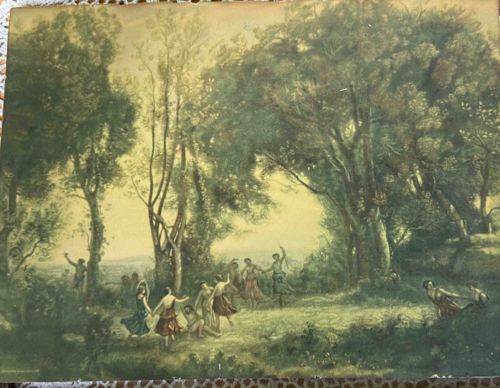
This item is a historical print or reproduction of Jean-Baptiste-Camille Corot's painting, 'Morning, The Dance of the Nymphs'. The print depicts a bucolic forest scene bathed in soft, diffused light, characteristic of the Barbizon School. Numerous classical figures, identified as nymphs, are engaged in a lively dance in a clearing under large, ancient trees. Their poses suggest movement, grace, and merriment. The color palette is dominated by verdant greens and earthy browns of the foliage, contrasted with a hazy, yellowish sky that signifies morning light. Some nymphs wear draped garments in shades of green, brown, and possibly red, while others appear partially unclothed, consistent with mythological themes. The overall impression is one of idyllic nature and classical mythology. The visual quality suggests it is a lithograph or a similar printmaking technique, possibly a chromolithograph, given the range of colors, or even a photographic reproduction of the painting. The print appears to be mounted on a board or stiff paper. The edges of the print show some wear, discoloration, and minor damage, including abrasions and possibly small tears on the top and bottom edges, suggesting age and handling. The resolution of the image makes it difficult to discern specific artist signatures or publisher marks, but the subject matter and style clearly point to Corot. The visible texture and tonal variations indicate a print rather than an original painting. The craftsmanship reflects the printing capabilities of its era, aiming to reproduce the nuanced brushwork and atmospheric quality of Corot's original. Given the subject and likely printing method, it probably dates from the late 19th to early 20th century.
AI Appraisal Report
Based on my examination of the provided image of 'Morning, The Dance of the Nymphs' and the accompanying description, I assess this item to be a historical print or reproduction of Jean-Baptiste-Camille Corot's famous painting. The visual quality, including discernible texture and tonal variations, confirms it as a print, likely a lithograph or chromolithograph, rather than an original painting. Its probable date of production falls into the late 19th to early 20th century.
The print's condition is fair to good for its age, showing signs of wear consistent with historical items. I noted discoloration, abrasions, and potential small tears on the edges, suggesting handling and age. These condition issues detract somewhat from the overall aesthetic appeal and, consequently, the value.
Market conditions for historical prints of well-known artworks by masters like Corot are generally stable. While original Corot paintings command significant prices, prints are much more accessible. Comparables in similar condition and print type typically range from modest to moderate values. This print is not rare; many reproductions of Corot's work were produced. Demand exists primarily from collectors interested in historical prints, Barbizon School art, or Corot specifically, at an affordable entry point.
The main factors impacting its value are its status as a reproduction, its age, and its condition. The lack of a clear artist's signature or publisher's mark, while not uncommon for such prints, prevents attributing it to a specific printmaker, which could potentially increase value. Without a physical inspection, specific printmaking techniques (e.g., etching, mezzotint) cannot be definitively confirmed, nor can the precise type of paper or mounting board. An in-person examination would allow me to thoroughly assess the print's exact condition, paper quality, printing process, and search for blind stamps or watermarks. Provenance documentation would be crucial for verifying any specific historical significance or limited edition status, if applicable, which could significantly impact authenticity and value beyond a general historical print. Scientific testing, such as pigment analysis, would be necessary for verifying specific dating or print techniques in greater detail, though this is rarely performed on common prints of this nature.