AI estimate as of September 27, 2025 · verify with a professional before acting
AI-Generated · Verify before acting
Everything on this page is generated by AI for informational purposes only. AI can make mistakes — the AI may misidentify items or misattribute them (artist, maker, brand, designer, origin, era). This is not an official valuation and should not be used for insurance, sale, tax, estate, legal, or lending purposes — or any decision requiring a certified appraisal. It is not an authoritative claim about any person, brand, or rights holder — do not share or rely on it as a factual statement about a third party. Always consult qualified professionals before making financial decisions.
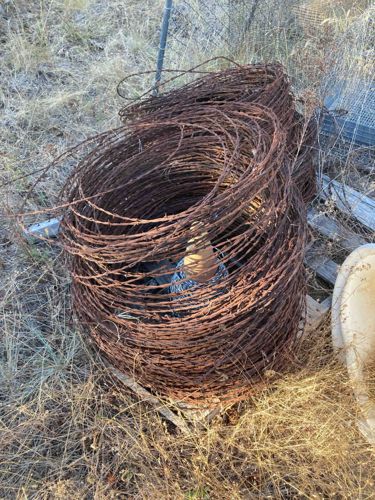
The item consists of several large, tightly wound rolls of barbed wire, characterized by a pervasive and heavy reddish-brown rust covering the entirety of the metal surfaces. The wire appears to be constructed from steel, typical for barbed wire, and is largely obscured by the thick layer of oxidation, making the original gauge or coating (e.g., galvanized) difficult to ascertain. Each roll is somewhat irregularly shaped, indicating a hand-wound or repurposed origin rather than factory-fresh coiling. The individual barbs are sharply pointed and spaced along the main strands, though their exact configuration (e.g., two-point, four-point) is challenging to determine due to the rust and density of the rolls. The total mass suggests a significant quantity of wire, likely several hundred feet per roll. There are no discernible manufacturer's marks, stamps, or labels visible on any of the rolls. Given the advanced state of rust and the outdoor setting, the wire is in a significantly deteriorated condition, indicating a long period of exposure to elements. This condition suggests it is likely old, possibly from the mid-20th century or earlier, depending on its history and storage. The overall aesthetic is one of aged, industrial material, lending itself to potential use in rustic decor or as scrap metal. No repairs are evident, and the primary condition issue is extensive corrosion.
AI Appraisal Report
Upon examining the provided image of the 'Rolls of Heavily Rusted Barbed Wire,' my assessment is that these items hold very limited monetary value, primarily as scrap metal. The pervasive and heavy reddish-brown rust covering all surfaces indicates significant deterioration due to prolonged exposure to the elements, consistent with a long period outdoors. This advanced state of corrosion suggests the wire is entirely unsuitable for its original intended use as fencing material, as its structural integrity would be severely compromised. I observe irregular coiling, which suggests either hand-winding or an older, less standardized manufacturing process, supporting the possibility of mid-20th century or earlier origin. However, without visible manufacturer's marks or labels, and given the obscured nature of the wire due to rust, authenticity beyond 'barbed wire' is impossible to determine visually.
Market conditions for heavily rusted barbed wire as fencing material are essentially non-existent. Its primary market is limited to scrap metal yards or, to a lesser extent, individuals seeking weathered industrial aesthetics for decorative purposes (e.g., rustic decor, art installations). There is no rarity associated with common barbed wire, even aged, and demand is minimal. Factors significantly impacting value are the deteriorated condition and the inherent lack of intrinsic value beyond its base metal content. Scrap metal prices fluctuate, but even at their peak, heavily integrated rust reduces the net usable metal content. The total mass per roll indicates a 'significant quantity,' potentially several hundred feet, which at current scrap steel prices (typically pennies per pound), would still only yield a low return.
Limitations in authentication are considerable. From images alone, I cannot definitively ascertain the original gauge, galvanization (if any), specific barb configuration, or exact steel composition. A physical examination would allow for precise weighing, a better assessment of the true extent of corrosion versus usable metal, and potentially the discovery of hidden markings. Provenance documentation (e.g., bills of sale, historical records) would be crucial for determining any historical significance that might elevate its value beyond scrap, but based on its appearance, this is highly unlikely.