AI estimate as of August 21, 2025 · verify with a professional before acting
AI-Generated · Verify before acting
Everything on this page is generated by AI for informational purposes only. AI can make mistakes — the AI may misidentify items or misattribute them (artist, maker, brand, designer, origin, era). This is not an official valuation and should not be used for insurance, sale, tax, estate, legal, or lending purposes — or any decision requiring a certified appraisal. It is not an authoritative claim about any person, brand, or rights holder — do not share or rely on it as a factual statement about a third party. Always consult qualified professionals before making financial decisions.
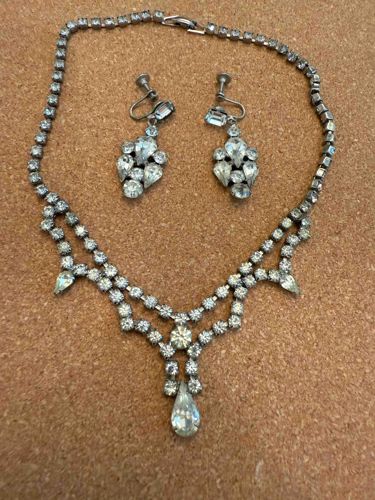
This is a vintage rhinestone necklace and matching screw-back earring set, likely dating from the mid-20th century, possibly the 1940s to 1960s, a period known for elaborate costume jewelry. The entire set features numerous clear, faceted rhinestones, closely set to maximize sparkle and mimic the appearance of diamonds. The metal appears to be a silvery-toned base metal, possibly rhodium-plated brass or pot metal, common for costume jewelry of this era to prevent tarnishing. The necklace is a graduated design, featuring a single strand of round rhinestones forming the choker portion, connected by small, squared links. This main strand leads into a more elaborate Y-shaped or décolletage design, composed of two parallel strands adorned with smaller round rhinestones, which converge at a larger central round rhinestone. Below this, a single teardrop-shaped rhinestone dangles as a focal point. The construction of the necklace shows individual settings for each stone, suggesting a certain level of craftsmanship. The necklace closes with a traditional hook clasp, which appears functional. The matching earrings are dangles, each featuring a cluster of varied-sized clear rhinestones, including round, marquise, and pear-shaped cuts, arranged in an appealing, somewhat floral or cascading design. They are attached to screw-back mechanisms, indicating their vintage nature, as pierced ears were less common in earlier parts of the 20th century. The overall condition appears to be good for its age, though some stones may show slight clouding or darkening of their foiled backs, which is typical for vintage rhinestones and contributes to their authentic patina. There are no obvious missing stones, and the metal appears to have retained its silver tone fairly well, with minimal visible wear or oxidation on the surface. The craftsmanship, while not fine jewelry, is indicative of a well-made costume piece designed for visual impact.
AI Appraisal Report
Upon visual examination of this Vintage Clear Rhinestone Necklace and Screw-Back Earring Set, I've assessed its condition and authenticity as good for its age, consistent with mid-20th-century costume jewelry (1940s-1960s). The design, screw-back mechanisms, and base metal construction are authentic to the period. The absence of obvious missing stones and relatively preserved silver tone indicate good care. Market conditions for vintage costume jewelry, especially complete sets, show steady demand. This piece, while not rare, represents a classic example of its era's aesthetic. Values are primarily driven by condition, completeness, and visual appeal. The craftsmanship is typical for well-made costume pieces, designed for visual impact rather than intrinsic material value. Limitations in authenticity verification from images alone include precise material identification (e.g., rhodium-plated vs. pot metal) and definitive assessment of stone integrity (foiling, minor abrasions). A physical inspection would allow for examination of stone settings, clasp functionality, and overall integrity. Provenance documentation would be ideal but is rarely available for such items. Scientific testing would be needed only if material composition were critical for valuation, which is generally not the case for common costume jewelry.