AI estimate as of October 11, 2025 · verify with a professional before acting
AI-Generated · Verify before acting
Everything on this page is generated by AI for informational purposes only. AI can make mistakes — the AI may misidentify items or misattribute them (artist, maker, brand, designer, origin, era). This is not an official valuation and should not be used for insurance, sale, tax, estate, legal, or lending purposes — or any decision requiring a certified appraisal. It is not an authoritative claim about any person, brand, or rights holder — do not share or rely on it as a factual statement about a third party. Always consult qualified professionals before making financial decisions.
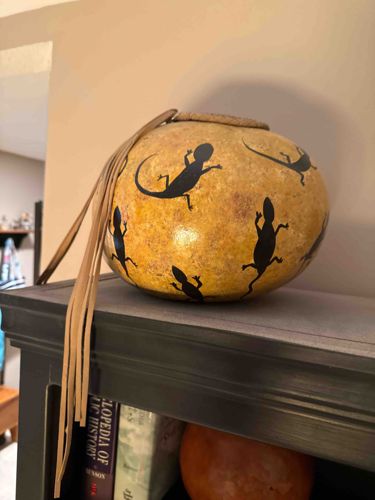
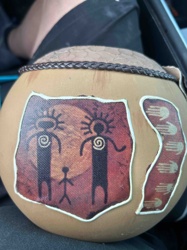
This item is a decorative art piece crafted from a dried gourd, exhibiting a spherical or slightly ovoid shape. Its primary color is a warm, earthy yellow-ochre, achieved through painting or staining, with subtle variations in tone that give it a somewhat mottled or antique appearance. The surface is adorned with multiple black painted silhouettes of lizards or geckos, dynamically positioned around the body of the gourd as if in motion. Each lizard figure is simple yet distinct. A notable feature is a series of light brown, possibly rawhide or faux-leather, strips attached near the top 'neck' of the gourd, hanging down one side. These strips appear to be cut precisely and add a textural contrast. Around the opening at the top, a thin, coiled string or rope-like element, also in a natural brown hue, is wrapped, serving as a decorative trim and potentially securing the hanging strips. The overall impression suggests a style inspired by Southwestern or Native American art, often featuring indigenous animals. There are no obvious signs of significant damage or wear visible in the image, such as cracks, chips, or excessive fading, indicating it is likely in good condition. The craftsmanship appears to be folk art or artisanal due to the hand-painted nature and natural material. Its size appears substantial enough to be a prominent decorative accent on a shelf or table. The material, design motifs, and decorative elements point to a modern decorative piece, likely from the late 20th or early 21st century.
AI Appraisal Report
Based on my visual examination of the provided image, this Gourd Art with Lizard Motifs appears to be in good overall condition. There are no readily apparent signs of significant damage such as cracks, chips, or major paint loss, suggesting it has been well-preserved. The craftsmanship indicates it is likely a modern decorative folk art piece, probably dating from the late 20th to early 21st century. The use of natural gourds, hand-painted motifs, and rustic materials like the rawhide/faux-leather strips and coiled string is characteristic of Southwestern or Native American inspired decorative arts.
Authenticity: Without physical examination, I cannot definitively verify the age of the gourd itself, the precise materials used for the strips (e.g., real rawhide vs. synthetic), or the exact method of painting. A tactile inspection would confirm material composition and craftsmanship quality more thoroughly. Provenance documentation could help establish its origin, artist, or specific cultural context, which would significantly impact its authenticity and value if it were an historically or culturally significant piece.
Market Conditions: The market for decorative gourd art, particularly contemporary pieces, is generally stable but not highly collectible in the same way as fine art. Comparable items often sell in the retail market through online craft stores, artisan markets, or specialty home decor shops. Demand is typically driven by interior design trends or a general appreciation for handcrafted items, rather than investment potential. The lizard motif is popular and broadly appealing.
Factors Impacting Value: The primary factors influencing its value are its decorative appeal and condition. If a renowned artisan created it, or if it had direct documented ties to an indigenous community, the value could be considerably higher. However, based solely on the image, it presents as a nicely executed, mass-produced or individually crafted decorative item rather than a collectible artifact. The lack of an identifiable artist or provenance limits its appeal to a broader collecting market.
In-person examination would involve assessing the quality of the gourd (e.g., thickness, curing), the application technique of the paint, and the exact material composition of the attachments to determine if they are genuine traditional materials or modern imitations.