These notes were written by the person who submitted this item. Appraiser.AI has not verified them, and the AI's identification and estimate may rely on them.
AI Estimated Value
Not an official valuation
$350-550
AI estimate as of November 27, 2025 · verify with a professional before acting
AI-Generated · Verify before acting
Everything on this page is generated by AI for informational purposes only. AI can make mistakes — the AI may misidentify items or misattribute them (artist, maker, brand, designer, origin, era). This is not an official valuation and should not be used for insurance, sale, tax, estate, legal, or lending purposes — or any decision requiring a certified appraisal. It is not an authoritative claim about any person, brand, or rights holder — do not share or rely on it as a factual statement about a third party. Always consult qualified professionals before making financial decisions.
This analysis also relies on unverified notes provided by the user, which may be incomplete or inaccurate and could affect the result.
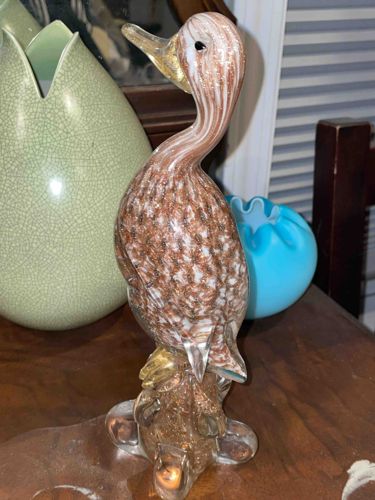
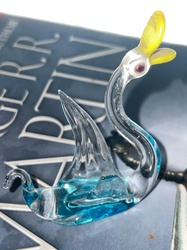
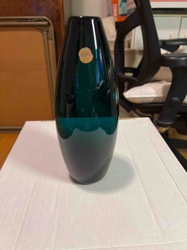
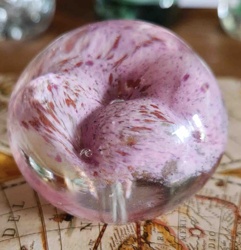
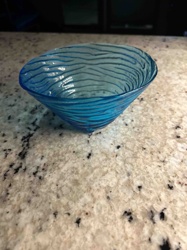
This is a Murano art glass figurine depicting a standing duck or a similar wading bird. The piece exhibits characteristic Murano glass techniques, particularly the use of Aventurine – a glass infused with metallic flecks (often copper) to give a shimmering, sparkly effect. The body of the duck is predominantly a rich, reddish-brown aventurine, possibly created with copper or gold dust, interspersed with opaque white glass, giving it a mottled or feathered appearance. The neck is long and gracefully curved, transitioning from the aventurine body to a lighter, more translucent gold or amber-colored glass culminating in a pointed beak. Small, dark, possibly black, glass accents form the eyes. The duck stands on a clear, elaborate glass base that mimics a natural element like reeds or a rocky outcrop, also containing some of the aventurine elements, which provides stability. The craftsmanship suggests it is hand-blown and shaped, with minor imperfections indicative of artisanal production rather than mass manufacturing. The overall condition appears good, with no visible chips, cracks, or repairs from the provided image; however, closer inspection would be needed to confirm. The style points towards mid-20th century Murano glass, a period known for its imaginative animal sculptures and decorative objects, likely made in Italy.
AI Appraisal Report
I have examined the provided image of what appears to be a Murano art glass duck figurine. The piece showcases classic Murano techniques, particularly the use of Aventurine glass, which gives the reddish-brown body its characteristic shimmer due to metallic flecks. The combination of aventurine with opaque white glass for a mottled, feathered effect, and the transition to a lighter, amber-colored neck and beak, is well-executed. The black glass eyes add definition. The clear, elaborate base with integrated aventurine further enhances the piece's stability and aesthetic. The craftsmanship suggests it is hand-blown and shaped, consistent with artisanal production rather than mass manufacturing.
Based on visual examination, the condition appears to be very good with no apparent chips, cracks, or repairs. However, a physical inspection would be crucial to confirm this definitively. Authenticity, while strongly indicated by the style and described techniques, cannot be fully verified from images alone. A hands-on examination would allow for closer inspection of pontil marks, internal inclusions, and glass quality. Provenance documentation, such as original purchase receipts or artist signatures/labels, would offer the strongest authentication.
In terms of market conditions, Murano animal sculptures, especially those featuring aventurine, maintain a steady demand among collectors. Similar pieces from the mid-20th century, a likely period of origin given the style, fetch reasonable prices. Rarity for this specific design is moderate; while many Murano ducks exist, the particular combination of aventurine, opaque white, and the elaborate base contributes to its appeal. Factors impacting value include its excellent apparent condition, the skilled use of aventurine, and its decorative appeal.
Considering these factors, and acknowledging the limitations of image-only appraisal for full authentication and condition assessment, I estimate the appraisal value to be between $350 and $550.