AI estimate as of September 2, 2025 · verify with a professional before acting
AI-Generated · Verify before acting
Everything on this page is generated by AI for informational purposes only. AI can make mistakes — the AI may misidentify items or misattribute them (artist, maker, brand, designer, origin, era). This is not an official valuation and should not be used for insurance, sale, tax, estate, legal, or lending purposes — or any decision requiring a certified appraisal. It is not an authoritative claim about any person, brand, or rights holder — do not share or rely on it as a factual statement about a third party. Always consult qualified professionals before making financial decisions.
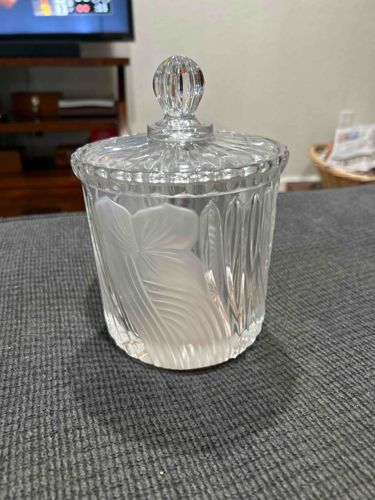
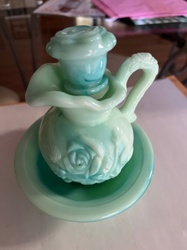
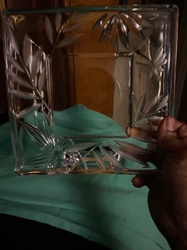
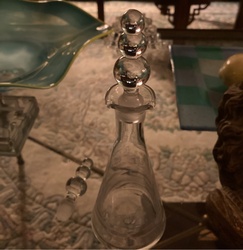
This item is a clear glass lidded candy dish or trinket jar, exhibiting a classic, somewhat ornate design. Physically, it stands upright, appearing to be crafted from molded clear glass, giving it a substantial and elegant feel. The body of the jar features vertical fluting or ribbing, which creates a textured surface that reflects light beautifully. On one side, there is a prominent frosted glass design depicting a large, stylized flower, possibly a hibiscus or similar tropical bloom, with delicate radiating lines indicating petals and leaves. This frosted detail contrasts nicely with the clear glass, adding a decorative element. The lid is also made of clear glass, with radial facets or fluting extending from its center, culminating in a decorative, faceted finial or knob at the top, likely for easy gripping. The craftsmanship appears to be commercial grade, indicative of mass production, but with attention to detail in the molding and frosting. There are no immediately visible condition issues such as chips, cracks, or significant abrasions from the provided image; the glass appears clean and intact, suggesting good preservation or light use. No specific maker's marks or signatures are discernible. Based on the style, particularly the frosted floral detail and faceted knob, this piece likely dates from the mid-to-late 20th century, possibly 1970s-1990s, aligning with common patterns of decorative glassware during that period. It serves a functional purpose for storage while also acting as an attractive decorative accent.
AI Appraisal Report
Upon visual examination of the provided image, this Frosted Floral Pattern Glass Lidded Candy Dish appears to be in excellent condition. The glass is clear and bright, and I observe no chips, cracks, or significant abrasions on either the body or the lid. The frosted floral design is intact, and the faceted finial shows no damage. This robust condition significantly maintains its decorative and functional appeal.
This piece, with its classic molded clear glass, vertical fluting, frosted floral motif, and faceted lid, is characteristic of commercially produced decorative glassware from the mid-to-late 20th century. My assessment places its likely manufacturing period between the 1970s and 1990s. While elegant, the design and production methods suggest mass-market intent rather than artisanal creation.
In terms of market conditions, similar clear glass candy dishes or trinket jars are readily available on secondary markets, including online platforms and antique malls. Demand for such items is generally modest, primarily driven by collectors of vintage glassware or individuals seeking decorative accents. The lack of specific maker's marks or a renowned designer limits its appeal to specialized collectors, thus impacting its high-end value.
Rarity is low; this general style was widely produced. The value is primarily influenced by its excellent condition and aesthetic appeal, rather than extreme scarcity or historical significance. Factors that would negatively impact its value, such as damage or significant wear, are absent here.
It is important to note the limitations of an appraisal based solely on images. While the visual indicators are strong, a full authentication would require in-person examination to check for subtle imperfections, confirm tactile qualities, identify any faint maker's marks or patent numbers, or verify the exact type of glass. Provenance documentation, though unlikely for such a common item, would also add certainty. Scientific testing is generally not cost-effective or necessary for items of this common vintage.