These notes were written by the person who submitted this item. Appraiser.AI has not verified them, and the AI's identification and estimate may rely on them.
AI Estimated Value
Not an official valuation
$600 - $900
AI estimate as of August 23, 2025 · verify with a professional before acting
AI-Generated · Verify before acting
Everything on this page is generated by AI for informational purposes only. AI can make mistakes — the AI may misidentify items or misattribute them (artist, maker, brand, designer, origin, era). This is not an official valuation and should not be used for insurance, sale, tax, estate, legal, or lending purposes — or any decision requiring a certified appraisal. It is not an authoritative claim about any person, brand, or rights holder — do not share or rely on it as a factual statement about a third party. Always consult qualified professionals before making financial decisions.
This analysis also relies on unverified notes provided by the user, which may be incomplete or inaccurate and could affect the result.
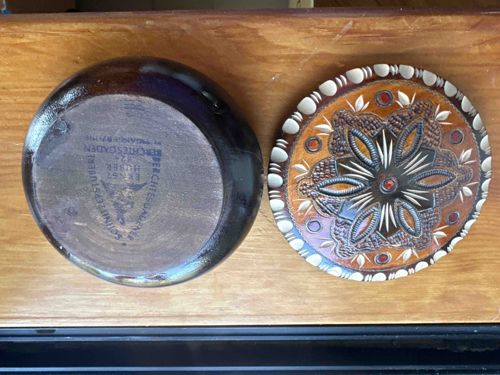
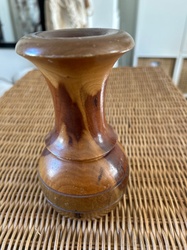
This appears to be a small lidded container, likely a trinket box or tobacco jar, crafted from ceramic for the base and wood for the lid. The base is a dark, possibly purplish-brown, glazed ceramic, exhibiting a smooth, reflective surface. The bottom of the ceramic base features an impressed or stamped mark in a circular formation, indicating 'ERNEST HUBER' and 'BERCHTESGADEN', along with what appears to be 'SCHNITZERKURS / 1927'. A stylized 'B' with a small figure or crest inside is also visible. This inscription suggests a German origin, potentially from a carving course or workshop in Berchtesgaden dating to 1927. The wooden lid is intricately carved with a central rosette or starburst motif, encircled by a pattern of stylized leaves and geometric shapes. intermittent with small, circular inlays or embellishments that appear to be red in color, possibly glass or polished stone. The outer rim of the lid is adorned with a series of raised, rounded elements, contrasting with the warm brown tones of the main carving. The carving depth and detail indicate skilled craftsmanship. The overall condition appears good for its age, with a visible patina on both the ceramic base and the wooden lid, consistent with age and use. There are no obvious chips, cracks, or significant damage visible in the provided image, but minor surface wear is likely. The piece measures 2.5 inches tall and 5.5 inches wide, with a removable lid, making it a functional and decorative item. The combination of ceramic and carved wood with folk art elements is distinctive.
AI Appraisal Report
Based on my visual examination of the provided image and the owner's description, this Ernst Huber Berchtesgaden carved wood and ceramic lidded jar is a compelling item of decorative arts. The impressed mark 'ERNEST HUBER / BERCHTESGADEN / SCHNITZERKURS / 1927' with a 'B' emblem strongly indicates authenticity and provides a precise date and origin. The combination of dark glazed ceramic and intricately carved wood with folk art elements is distinctive and consistent with regional crafts from early 20th-century Germany. The craftsmanship, particularly on the wooden lid with its rosette motif, stylized leaves, and circular red inlays, suggests a skilled artisan.
The condition appears remarkably good for its age. While I observe a consistent patina on both materials, typical signs of age and use, there are no visible chips, cracks, or significant damage as presented in the image. Minor surface wear is to be expected but does not detract significantly from its aesthetic appeal. The removable lid and stated dimensions (2.5" tall, 5.5" wide) confirm it as a functional and decorative piece.
Market conditions for early 20th-century European folk art, particularly signed and dated pieces from known workshops or figures like Ernst Huber, generally show steady demand. The rarity here lies in the specific provenance and the combination of materials. Comparable items of this quality and documented origin often see interest from collectors of German decorative arts, folk art, and pre-war artisanal crafts. The specific 'Schnitzerkurs' (carving course) notation adds an intriguing layer of historical context.
Factors significantly impacting value include the documented origin, good condition, and the artistic quality of the carving. The unique combination of ceramic and wood is also a value driver. My primary limitation in this assessment is the lack of physical inspection. Without handling the item, I cannot confirm the exact material of the red inlays (e.g., glass, stone, or resin), thoroughly assess the interior condition, or feel for any subtle surface imperfections not visible in the image. Full authentication would benefit from in-person examination to confirm the impressed marks definitively, assess the wood type, and confirm the method of the red inlays. Provenance documentation beyond the base mark, such as original acquisition records, would also enhance certainty.
Considering all these factors, particularly the clear signature, date, and apparent good condition, I estimate its value.