AI estimate as of November 18, 2025 · verify with a professional before acting
AI-Generated · Verify before acting
Everything on this page is generated by AI for informational purposes only. AI can make mistakes — the AI may misidentify items or misattribute them (artist, maker, brand, designer, origin, era). This is not an official valuation and should not be used for insurance, sale, tax, estate, legal, or lending purposes — or any decision requiring a certified appraisal. It is not an authoritative claim about any person, brand, or rights holder — do not share or rely on it as a factual statement about a third party. Always consult qualified professionals before making financial decisions.
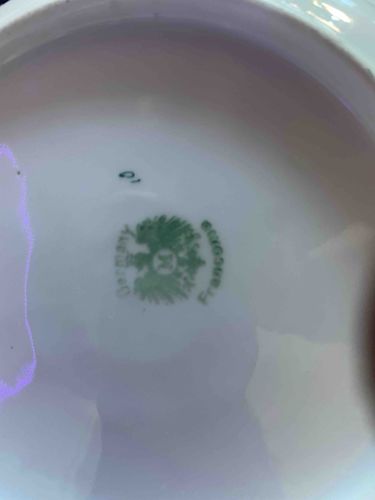
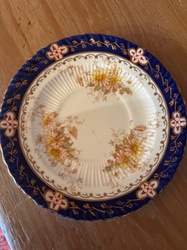
The item depicted is the backmark of a porcelain dish or plate. The primary observable physical characteristic is the white porcelain body, which appears to have a smooth, possibly glazed finish. The backmark itself is centrally located and printed in a dark green color. It consists of a stylized eagle or heraldic bird design, possibly with a crest or shield on its chest, surrounded by text. The text clearly reads "Germany" on the left side, curved vertically, and "Franconia" on the right side, also curved vertically. Above the main mark, there is a small black numeric or alphanumeric marking, appearing to be '01' or similar, possibly an inventory number, pattern number, or factory code. The overall condition of the backmark seems good, with clear, legible printing. There are no visible signs of wear, fading, or damage to the mark itself, suggesting the item has been well-preserved or is relatively newer. The porcelain surface around the mark also appears clean and free of cracks, chips, or significant discoloration. This 'Franconia Germany' mark is indicative of porcelain manufactured by Krautheim & Adelberg, particularly items intended for export. This mark style was widely used from the early 20th century, particularly post-World War II, through the mid-century, generally between the 1920s and 1960s. The quality of the mark suggests standard commercial porcelain production. The exact item the backmark belongs to cannot be determined from this image alone, but it signifies a piece of German-made tableware or decorative porcelain.
AI Appraisal Report
I have examined the provided image of the Franconia Germany porcelain backmark. The mark itself is clear, legible, and shows no signs of wear, fading, or damage, suggesting the item is in good to excellent condition in terms of its marking. The porcelain surface appears clean and free of obvious flaws. This 'Franconia Germany' mark is characteristic of porcelain produced by Krautheim & Adelberg, particularly for export markets, and was widely used post-World War II, generally from the 1920s to the 1960s. The small '01' above the mark is likely a factory or pattern identifier.
Authenticity, based purely on visual examination of this backmark, appears to be consistent with known examples of Krautheim & Adelberg's 'Franconia' line. The dark green color and stylization are typical. However, it is crucial to note that this appraisal is severely limited as I am only viewing a backmark and not the entire item. The condition, pattern, form, and overall quality of the actual dish or plate would significantly impact its value.
Market conditions for mid-century German export porcelain are generally stable but not highly speculative. While elegant, these pieces are relatively common. Demand is moderate, typically from collectors of European porcelain or those seeking vintage tableware. Rarity is low; 'Franconia' marked items are not scarce.
Factors significantly impacting value that cannot be assessed here include the item's form (e.g., platter vs. saucer), decorative pattern (some patterns are more desirable), overall condition of the porcelain body (chips, cracks, repairs, pattern wear), and completeness of sets if applicable. Without seeing the actual item, the value assigned here is solely for the *potential* of an intact, good-condition piece bearing this mark.
For full authentication and accurate valuation, an in-person examination of the entire piece is essential. This would allow for tactile inspection of the porcelain quality, detailed assessment of any pattern details or decoration, detection of repairs, and a more comprehensive condition report. Provenance documentation, while rare for such items, could also add to its historical value, but is not typically a major factor for this type of porcelain.