These notes were written by the person who submitted this item. Appraiser.AI has not verified them, and the AI's identification and estimate may rely on them.
AI Estimated Value
Not an official valuation
$40-70
AI estimate as of August 26, 2025 · verify with a professional before acting
AI-Generated · Verify before acting
Everything on this page is generated by AI for informational purposes only. AI can make mistakes — the AI may misidentify items or misattribute them (artist, maker, brand, designer, origin, era). This is not an official valuation and should not be used for insurance, sale, tax, estate, legal, or lending purposes — or any decision requiring a certified appraisal. It is not an authoritative claim about any person, brand, or rights holder — do not share or rely on it as a factual statement about a third party. Always consult qualified professionals before making financial decisions.
This analysis also relies on unverified notes provided by the user, which may be incomplete or inaccurate and could affect the result.
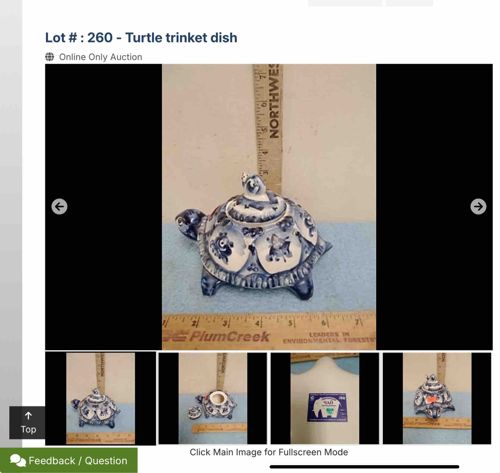
This item is a ceramic trinket dish designed in the form of a turtle, featuring a distinct blue and white color scheme reminiscent of Gzhel or Delftware pottery, sometimes associated with Russian folk art. The primary material appears to be glazed earthenware or porcelain. The turtle's shell serves as the lid for the trinket box, and it is intricately decorated with a series of small, individual pictorial scenes or vignettes, each framed by a scalloped or undulating border. These scenes depict various animals, including what appears to be a cat, a rabbit, and other indistinct creatures, rendered in a stylized, somewhat naive manner. The base of the turtle forms the dish itself, with four sturdy legs supporting the body. The head of the turtle is turned slightly to the viewer's left, with simple facial features. A smaller, very detailed turtle figurine acts as the finial or handle on top of the lid, adding a charming, hierarchical element to the design. The blue coloration exhibits variations in intensity, from deep cobalt to lighter shades, creating depth and highlighting the brushwork. The white background provides a stark contrast, allowing the blue designs to stand out prominently. The visible condition appears good with no obvious chips, cracks, or significant wear. The glaze exhibits a uniform sheen, suggesting good preservation. The craftsmanship appears to be of reasonable quality, with attention to detail in the painted motifs and the sculptural elements. The style suggests a decorative, perhaps collectible item, possibly dating from the late 20th century, given its mass-produced yet artisan-inspired aesthetic. The overall size, as indicated by the ruler in the image, is approximately 5-6 inches in length and about 4-5 inches in height, making it suitable for holding small jewelry or keepsakes.
AI Appraisal Report
Upon examining the provided image of this Blue and White Ceramic Turtle Trinket Dish, I assess its condition as good, with no overt chips, cracks, or significant wear visible. The uniform sheen of the glaze further supports this. The design, reminiscent of Gzhel or Delftware, with its intricate blue and white animal motifs, suggests a decorative collectible. The small turtle finial is a charming detail.
Market conditions for such decorative ceramic pieces are stable, with demand driven by collectors of folk art-inspired designs and trinket boxes. Comparables include similar mass-produced, artist-inspired ceramic wares from the late 20th century. While rare in the sense of finding an identical piece, the overall style points to a manufactured decorative item rather than a unique artisan creation, thus limiting its rarity for investment purposes. The craftsmanship is reasonable, but not exceptional, which impacts its upper value potential.
Factors impacting value include its decorative appeal, functional use as a trinket dish, and good condition. However, its likely mass-produced nature and absence of a known maker or definitive historical provenance hinder it from achieving high values.
It is crucial to note the limitations of remote examination: I cannot definitively confirm authenticity as ‘Russian’ without an in-person inspection to check for maker's marks, specific clay body characteristics, and direct comparison with known Gzhel or Russian folk art pieces. Physical examination would allow for closer inspection of the painting technique, glaze quality, and overall weight and feel. Provenance documentation (e.g., purchase receipts, certificates of authenticity) or scientific testing (e.g., thermoluminescence dating for age verification) would be needed for full authentication.