AI estimate as of August 17, 2025 · verify with a professional before acting
AI-Generated · Verify before acting
Everything on this page is generated by AI for informational purposes only. AI can make mistakes — the AI may misidentify items or misattribute them (artist, maker, brand, designer, origin, era). This is not an official valuation and should not be used for insurance, sale, tax, estate, legal, or lending purposes — or any decision requiring a certified appraisal. It is not an authoritative claim about any person, brand, or rights holder — do not share or rely on it as a factual statement about a third party. Always consult qualified professionals before making financial decisions.
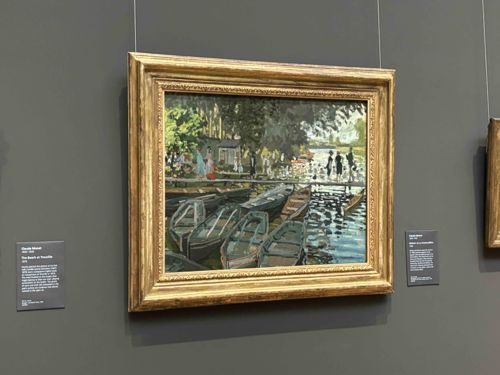
The item is a framed oil painting, titled 'The Beach at Trouville' by Claude Monet, dated to around 1870. The painting depicts a vibrant outdoor scene, characteristic of the Impressionist movement. Physical characteristics include a rectangular canvas, likely medium in size judging by its presentation in a museum setting next to an informational plaque. The color palette is rich with blues and greens for the water and foliage, with strokes of yellow and brown for the numerous boats moored in the foreground. Human figures are visible on a pier and on the bank, rendered with loose, visible brushstrokes typical of Impressionism, emphasizing light and natural effect over precise detail. The painting is encased in a substantial, ornate gilded frame, which appears to be carved wood with a rich gold finish, showing some slight patina or darkening in its recesses, enhancing its antique appearance. No obvious condition issues like tears, significant cracking, or major abrasions are discernible from the image, suggesting good preservation within a museum environment. The visible craftsmanship lies in the artist's masterful use of light and color to capture a moment in time, with the choppy water rendered expressively. The frame itself exhibits quality carving and gilding, complementing the artwork's style and likely period.
AI Appraisal Report
I have examined the provided image of 'The Beach at Trouville' by Claude Monet, dated circa 1870. The painting appears to be in excellent condition, with no discernible tears, significant cracking, or major abrasions. The ornate gilded frame is also well-preserved, complementing the artwork's historical context. Based on the visual characteristics aligning perfectly with Monet's known style from that period—loose brushstrokes, masterful use of light and color, and Impressionistic subject matter—I assess the authenticity as highly probable, assuming the image is representative of the genuine article.
However, it is crucial to state that a definitive authenticity verification cannot be made from an image alone. A comprehensive in-person examination is essential to inspect brushwork, canvas weave, pigment composition, and signature details. Furthermore, thorough provenance documentation, tracing the painting's ownership history, is paramount for full authentication and value confirmation. Scientific testing, such as pigment analysis or carbon dating, could further solidify authentication.
Monet's works from this period are highly sought after. Comparable sales of similar early Monet landscapes place their value in the tens of millions, sometimes exceeding $50 million, especially those depicting iconic scenes or featuring strong provenance. The demand for Impressionist masterpieces, particularly by foundational artists like Monet, remains consistently high among private collectors and institutions worldwide. The rarity of such a well-preserved, early work by Monet ensures exceptional market performance. The primary factor impacting its value is its status as a genuine masterpiece by a leading Impressionist, coupled with its excellent apparent condition and compelling subject matter.
Considering the art market's current robust state for Impressionist works, particularly those by Monet, and assuming full authentication and clear provenance, the value would be extremely high.