AI estimate as of July 25, 2025 · verify with a professional before acting
AI-Generated · Verify before acting
Everything on this page is generated by AI for informational purposes only. AI can make mistakes — the AI may misidentify items or misattribute them (artist, maker, brand, designer, origin, era). This is not an official valuation and should not be used for insurance, sale, tax, estate, legal, or lending purposes — or any decision requiring a certified appraisal. It is not an authoritative claim about any person, brand, or rights holder — do not share or rely on it as a factual statement about a third party. Always consult qualified professionals before making financial decisions.
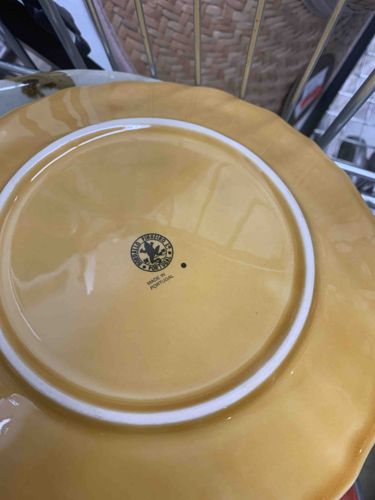
The item is the reverse side of a ceramic plate, likely a charger or large serving plate, characterized by its glossy, rich mustard-yellow glaze. The plate features a distinct scalloped or fluted edge, suggesting an organic or decorative design on its obverse side, which is not visible in the image. The glaze appears consistent, without major chips or cracks visible on this side, indicating good overall condition, although minor surface wear might be present that is not discernible at this resolution. The central foot ring is visible, providing stability when placed on a flat surface, and is left unglazed or has a white/off-white glazing. A prominent circular stamp, approximately 1.5 to 2 inches in diameter, is centered on the foot ring. This stamp contains manufacturing details: a stylized motif (possibly a crest or animal emblem, though unclear) at the top, and the text "MADE IN PORTUGAL" below it, indicating its country of origin. Below the text, a small black dot is visible, which could be a quality control mark, a production flaw, or a specific identifier. The craftsmanship appears to be of standard quality for mass-produced ceramic dinnerware, with uniform glazing and no obvious manufacturing defects on the visible surface. While an exact age cannot be determined without further information, the 'MADE IN PORTUGAL' stamp suggests it is a relatively modern piece, likely from the late 20th or early 21st century, consistent with the style of many ceramic items imported from Portugal.
AI Appraisal Report
Upon examining the image of this mustard-yellow glazed ceramic plate, I note its primary features indicative of its origin and potential value. The plate presents in what appears to be good condition, with a consistent, vibrant glaze and no visible chips or cracks on the reverse side. The key identifying feature is the "MADE IN PORTUGAL" stamp, which places its production within the latter half of the 20th century or more recently. This style of mass-produced, utilitarian, yet decorative ceramicware is common for Portuguese exports.
While functional and aesthetically pleasing, such plates are not considered rare. The market for contemporary Portuguese ceramics is driven by decorative appeal and utility rather than collector-driven rarity. Similar single, unmarked, or mass-market marked Portuguese plates and chargers are widely available on secondary markets. Comparables typically sell for modest sums, valued more for their decorative quality than for any specific maker's mark or historical significance.
The value is significantly impacted by its status as a single plate rather than a full set, and the lack of a known high-end manufacturer's mark. Its value lies primarily in its use as a replacement or decorative piece.
A definitive appraisal is limited by the inability to physically inspect the item. An in-person examination would be required to assess for hairline cracks, crazing, a clear view of the maker's emblem, and the condition of the obverse side, all of which could affect value. Full authentication would involve identifying the specific manufacturer from the stylized crest, which is not clear in the photograph.